5-Minute Pre-Market Meditation: Mindset Frequency Calibration & Emotional Circuit Breakers in Trading
5-Minute Pre-Market Meditation: Mindset Frequency Calibration & Emotional Circuit Breakers in Trading

Table of Contents
- 1. The 8:00 AM Neural Trap: The Invisible Adrenaline Storm
- 2. Financial Stress Neuroscience: When the Amygdala Locks Out Rationality
- 3. 3 Brainwave Bands During Execution: Decoding "Mindset Frequency"
- 4. Anatomy of the Standardized 5-Minute Pre-Market Ritual
- 5. Box Breathing 4-4-4-4: Activating the Vagus Nerve
- 6. Comparing Two Trader Archetypes: Adrenaline Chasers vs Alpha Performers
- 7. Robert Greene's Wisdom: Emotional Detachment as the Ultimate Edge
- 8. Interactive 5-Minute Readiness Checklist
- 9. Academic Research & Bibliography
01. The 8:00 AM Neural Trap: The Invisible Adrenaline Storm
"Financial markets impact our biological hardware directly. Unregulated physiological responses to dopamine and cortisol are the direct catalyst behind shattered risk discipline."
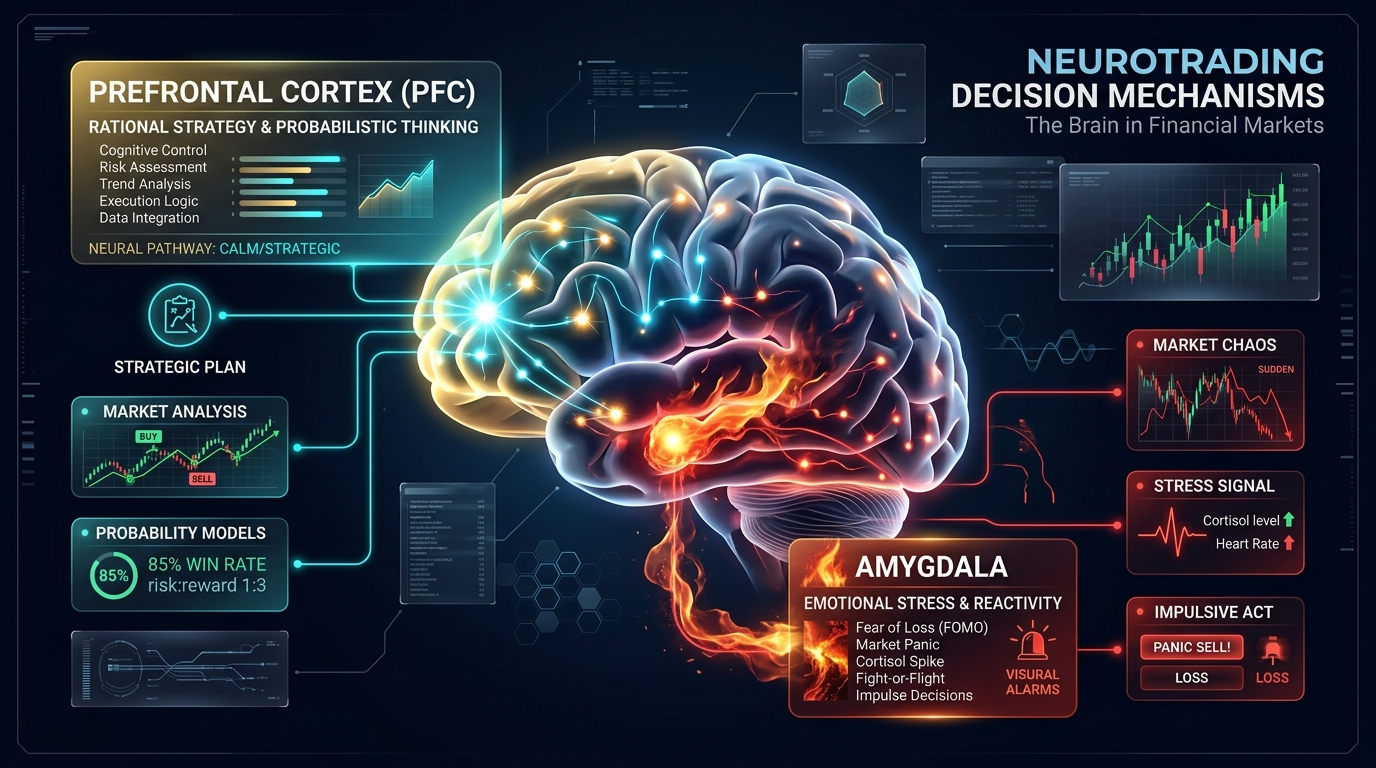
02. Financial Stress Neuroscience: When the Amygdala Locks Out Rationality
03. 3 Brainwave Bands During Execution: Decoding "Mindset Frequency"
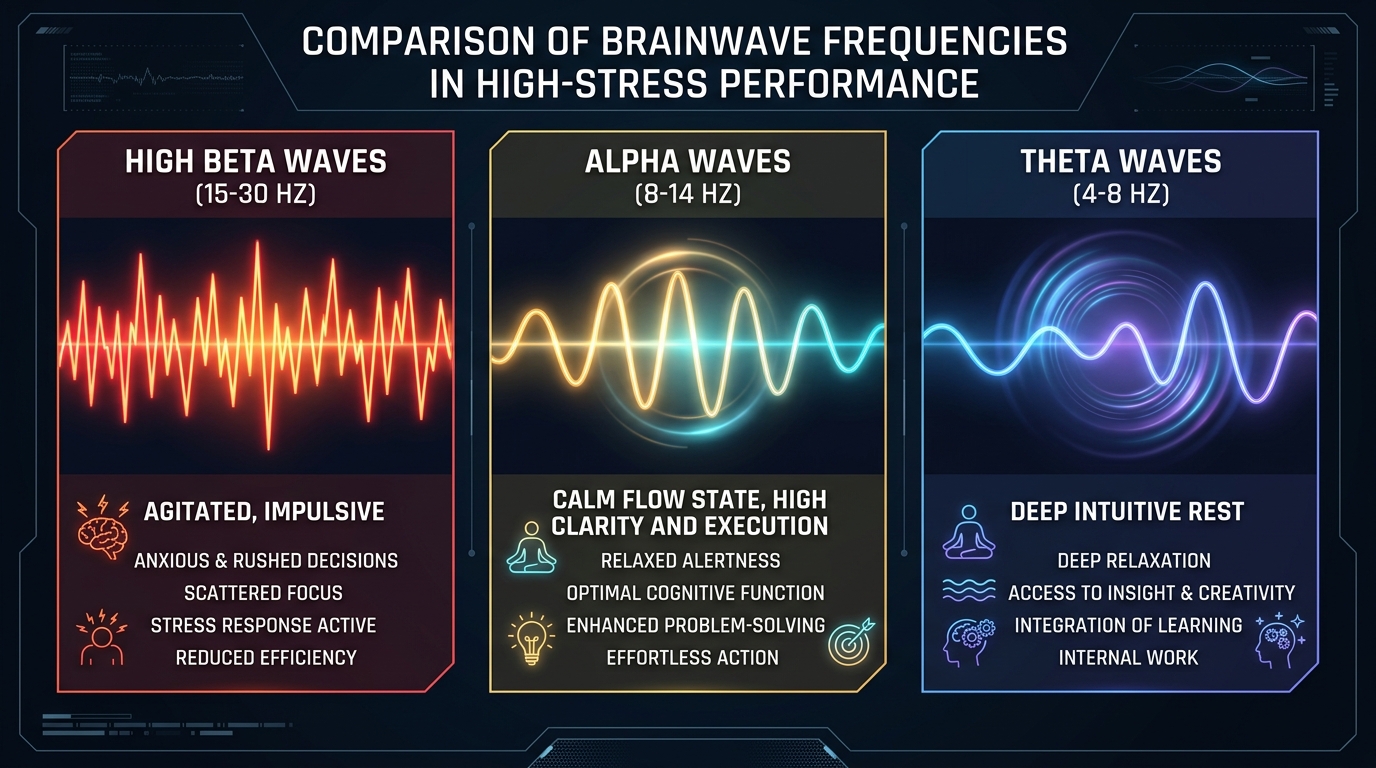
Alarm & Anxiety
Agitated mind, fear of missing out, revenge-trading impulse after losses. Hasty executions and improper stop-loss placement.
Relaxed Alertness
Stable heart rate, comprehensive multi-timeframe perspective. Free from euphoria during wins and panic during losses. Objective probabilistic execution.
Deep Rest & Synthesis
Deep meditative state or twilight awareness where neural networks integrate multi-year market patterns into refined subconscious intuition.
04. Anatomy of the Standardized 5-Minute Pre-Market Ritual
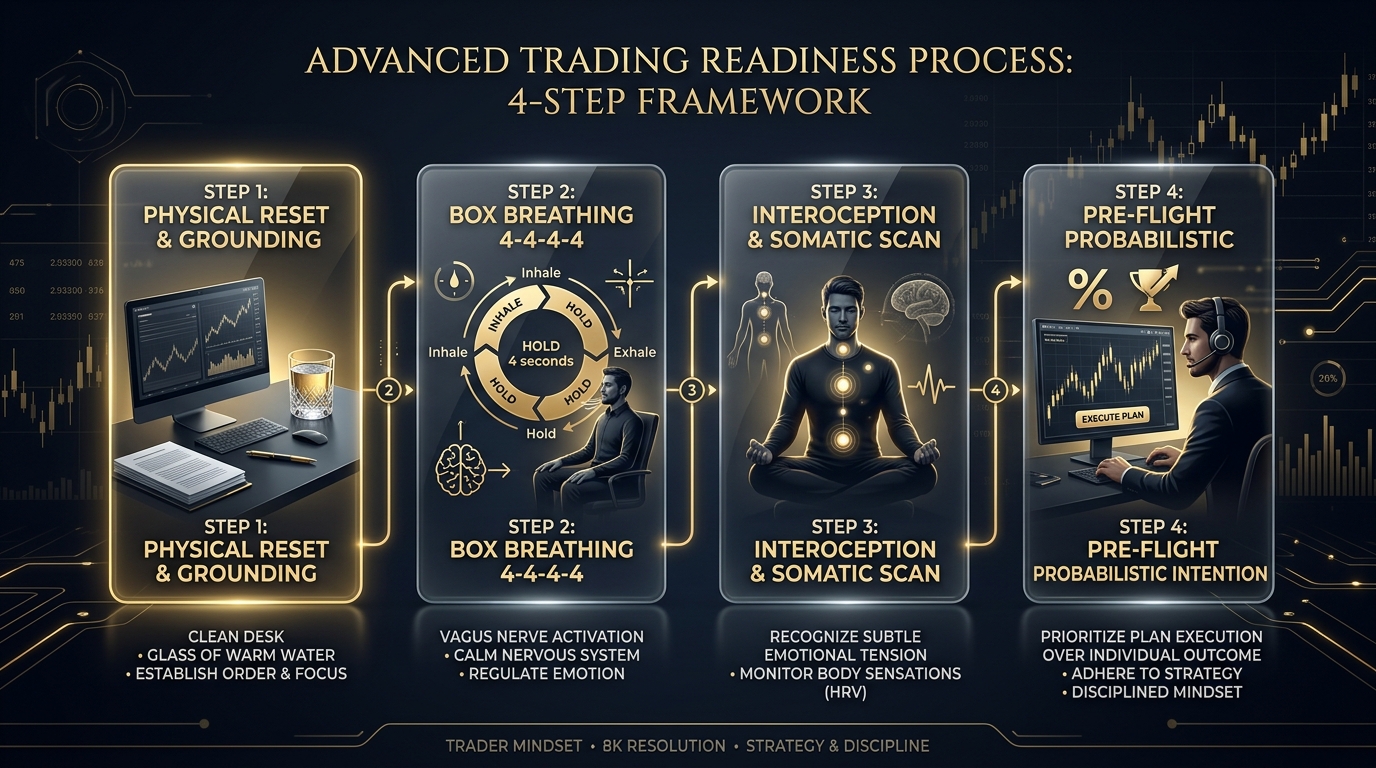
Minutes 0–1: Physical Grounding
Set aside your phone and close noisy chat channels. Drink warm water. Sit upright with both feet flat on the floor to establish physical stability. Release jaw tension and drop your shoulders.
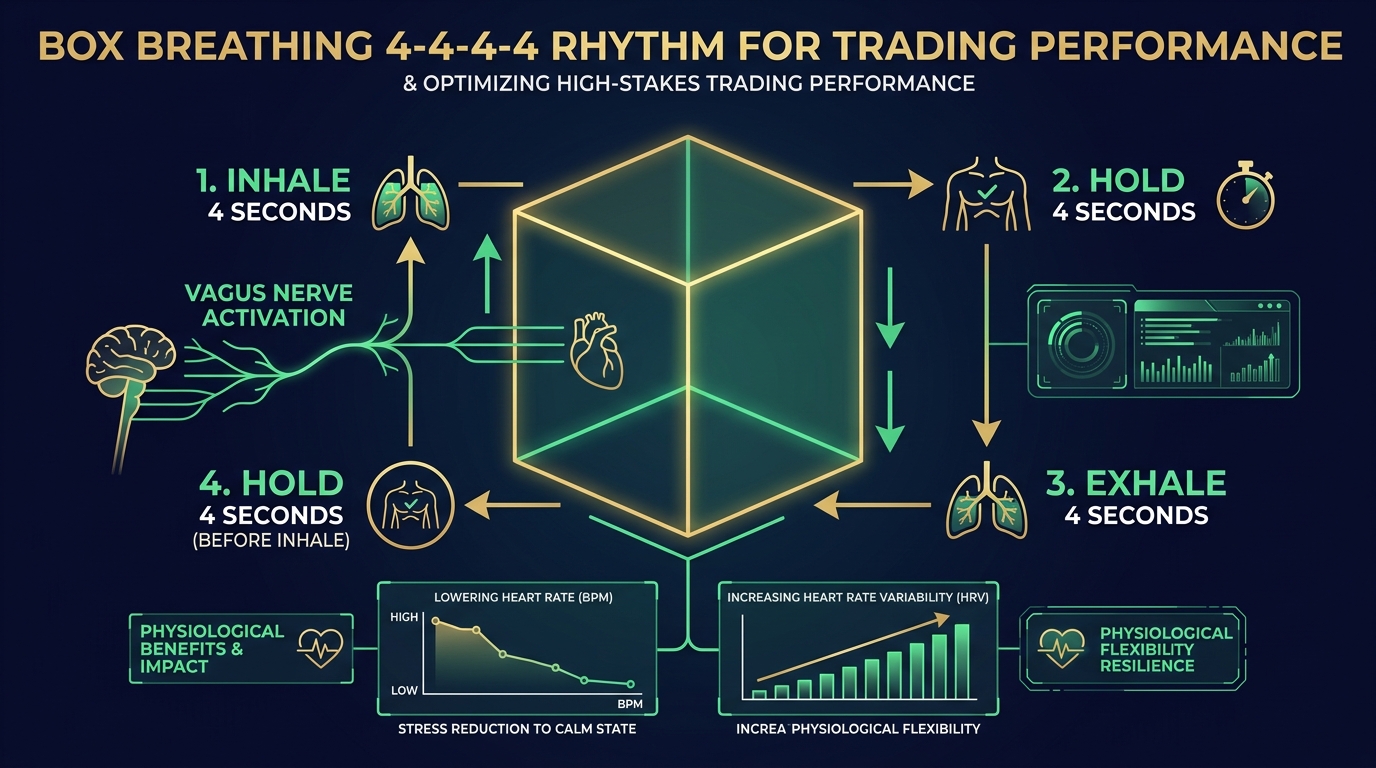
Minutes 1–3: Box Breathing 4-4-4-4 (Vagus Nerve Activation)
Perform 4–6 cycles of square breathing: Inhale 4s through nose, Hold 4s, Exhale 4s through mouth, Hold empty 4s. This directly stimulates the Vagus nerve, lowering heart rate and stabilizing Heart Rate Variability (HRV).
Minutes 3–4: Interoception & Somatic Scan
Ask yourself 3 quick questions: "Is there tightness in my chest?", "Am I feeling revenge-oriented due to yesterday's trades?", "What is my energy score out of 10?". If unsettled, reduce position sizing by 50% or take a pause today.
Minutes 4–5: Pre-Flight Probability Intention
Reaffirm Mark Douglas's core principle: "This next trade has an entirely random outcome, and that is completely normal in probability. My value is tied to executing my plan. My long-term edge unfolds across 100 consecutive trades."
05. Box Breathing 4-4-4-4: Activating the Vagus Nerve
06. Comparing Two Trader Archetypes: Adrenaline Chasers vs Alpha Performers
| Evaluation Criteria | Adrenaline Chaser | Alpha Frequency Trader (5-Min Ritual) |
|---|---|---|
| Pre-Session Entry | Frantic, hunting signals across chats | Serene, completed 5-min ritual, grounded |
| Brainwave State | High Beta (18–30 Hz) — Stress, FOMO | Alpha (8–14 Hz) — Deep clarity, calm |
| Impulse Spikes | Chases market tops fearing missing out | Patiently waits for retests at key levels |
| Loss Response | Anger, revenge trades with double size | Logs trade objectively as standard cost |
| Long-Term Outcome | Capital decay and burnout within months | Compounding account growth & peace of mind |
07. Robert Greene's Wisdom: Emotional Detachment as the Ultimate Edge

⚡ 5-Minute Pre-Market Readiness Checklist
Check off completed steps to calculate your Pre-Market Ready Score.
Academic Bibliography & References
- Coates, J. (2012). The Hour Between Dog and Wolf: Risk Taking, Gut Feelings, and the Biology of Boom and Bust. Penguin Books.
- Douglas, M. (2000). Trading in the Zone: Master the Market with Confidence, Discipline and a Winning Attitude. Prentice Hall Press.
- Huberman, A. (2021). Tools for Managing Stress & Anxiety. Huberman Lab Podcast, Stanford University School of Medicine.
- Steenbarger, B. N. (2006). Enhancing Trader Performance: Proven Strategies from the Cutting Edge of Trading Psychology. John Wiley & Sons.
- Dalio, R. (2017). Principles: Life and Work. Simon & Schuster.
- Greene, R. (2012). Mastery. Viking Adult.
- Taleb, N. N. (2001). Fooled by Randomness: The Hidden Role of Chance in Life and in the Markets. Texere.