Demystifying Revenge Trading Addiction: The Neuroscience Behind Loss And The 4-Step Neuro-Interruption Protocol
Demystifying Revenge Trading Addiction:
The Neuroscience Behind Loss And The 4-Step Neuro-Interruption Protocol
In-depth neuroscience and trading psychology study: Why 90% of investors blow up accounts within hours of a stop-loss, the reality of Amygdala Hijack, and the 4-step emotional interruption protocol to preserve capital.

01 EGO TRAP: WHEN A LOSING TRADE BECOMES PERSONAL INJURY
Imagine this familiar scenario: You spend the entire morning analyzing charts, identifying a pristine breakout pattern, and confidently opening a long position with standard position sizing. Yet just 15 minutes later, an abrupt red candle sweeps past your stop-loss and immediately surges back in your original target direction.
In that exact moment, your account lost only 1% of equity according to your predefined risk management plan. Numerically and economically, this is a completely routine event — an unavoidable cost of business within a probabilistic machine. But deep in your subconscious, you do not perceive it as an operational expense. You feel personally offended, believing the market is deliberately targeting your intellect and dignity.
"The fatal mistake of most traders is equating their personal self-worth with the outcome of a single trade. They view winning trades as proof of supreme intellect, and losing trades as an ego humiliation. When you treat the market as an enemy to conquer, you have officially stepped onto the path of financial self-destruction."
This bitter resentment rapidly fuels an instinctive reflex: You reopen the app, double your position size, bypass all standard candlestick filtration rules, and fire an opposing order to "take back money from the market". That is the precise moment Revenge Trading erupts.

02 AMYGDALA HIJACK: NEUROBIOLOGICAL MECHANISMS OF LOSING CONTROL
To master any psychological behavior, we must first understand the underlying neurobiological mechanisms driving it. Modern research from Stanford University and the Zurich Center for Neuroeconomics demonstrates that the human brain did not evolve to trade digital assets in an abstract probabilistic environment.
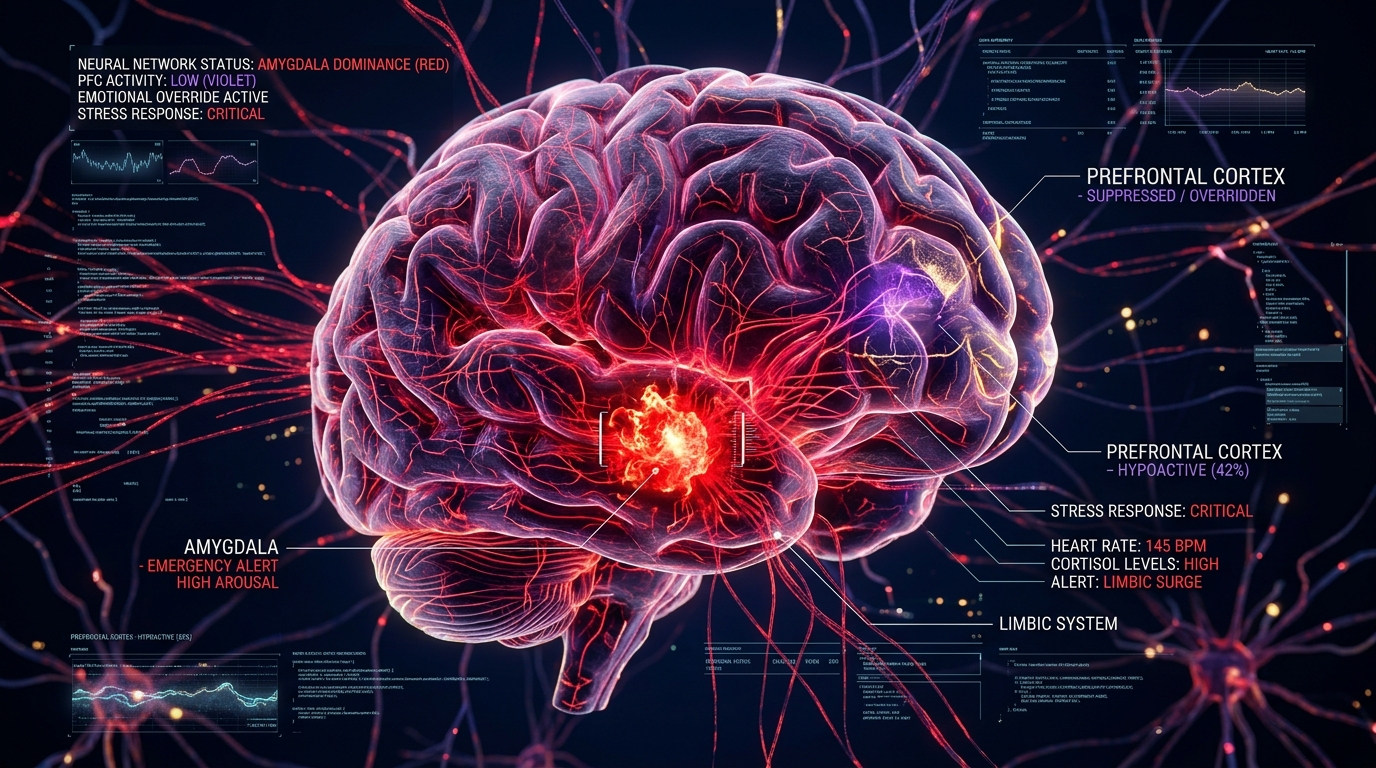
The Chain Reaction Inside The Brain Following A Stop-Loss Execution:
1. Activation of the Hypothalamic-Pituitary-Adrenal (HPA) Axis:
When your eyes register account balance reduction, the Amygdala — the survival fear center of the primitive brain — fires an emergency red alert. The adrenal glands flood the bloodstream with Cortisol and Adrenaline, causing heart rate spikes, elevated blood pressure, and shallow breathing.
2. The Prefrontal Cortex Shutdown Phenomenon:
The prefrontal cortex — responsible for mathematical probability calculations, disciplined execution, and strategic foresight — suffers restricted blood flow to prioritize primitive "Fight or Flight" survival reflexes. In this state, you cease to function as a rational investor; you morph into a primal creature aggressively counter-attacking perceived danger.
3. Loss of Probabilistic Assessment Capacity:
Under acute Cortisol saturation, your attention span collapses into mere seconds. You lose visibility over multi-timeframe candle structures, ignore risk-to-reward (R:R) ratios, and willingly stake 50% of your account just to seek immediate psychological relief.
03 DOPAMINE THIRST: THE DANGEROUS ILLUSION OF LUCKY RECOVERY TRADES
A primary reason revenge trading transforms into an intractable addiction lies in the biochemical reward circuitry of the neurotransmitter Dopamine.

Closing a losing position plunges brain Dopamine well below baseline levels, inducing feelings of emptiness, guilt, and despair. The fastest shortcut for the brain to trigger compensatory Dopamine release is executing high-risk action: Opening an aggressive oversized position.
The danger deepens further. Renowned behavioral psychologist B.F. Skinner identified the law of Intermittent Reinforcement: If in the past you took a reckless revenge trade and the market miraculously reversed to break-even or profit, your brain etched this toxic lesson as a successful survival blueprint.
Toxic Illusion: Winning On Flawed Execution Is Far More Dangerous Than Losing On A Disciplined Plan
Profiting from undisciplined execution injects psychological poison into your subconscious. You will inevitably repeat reckless position sizing in future sessions. In a strong one-way trending market, just a single non-reversing move will vaporize years of accumulated wealth within hours.
04 THE 4-QUADRANT MATRIX: SHIFTING FROM INSTINCTIVE COMBAT TO OBJECTIVE PROBABILISTIC EXECUTION
To permanently cure revenge trading, the revolutionary cognitive shift is completely overhauling how you evaluate any single trade. In the classic text Trading in the Zone, Mark Douglas emphasized: The outcome of any single trade is essentially random, but the outcome of a 100-trade series rigorously following positive expectancy is mathematically deterministic.
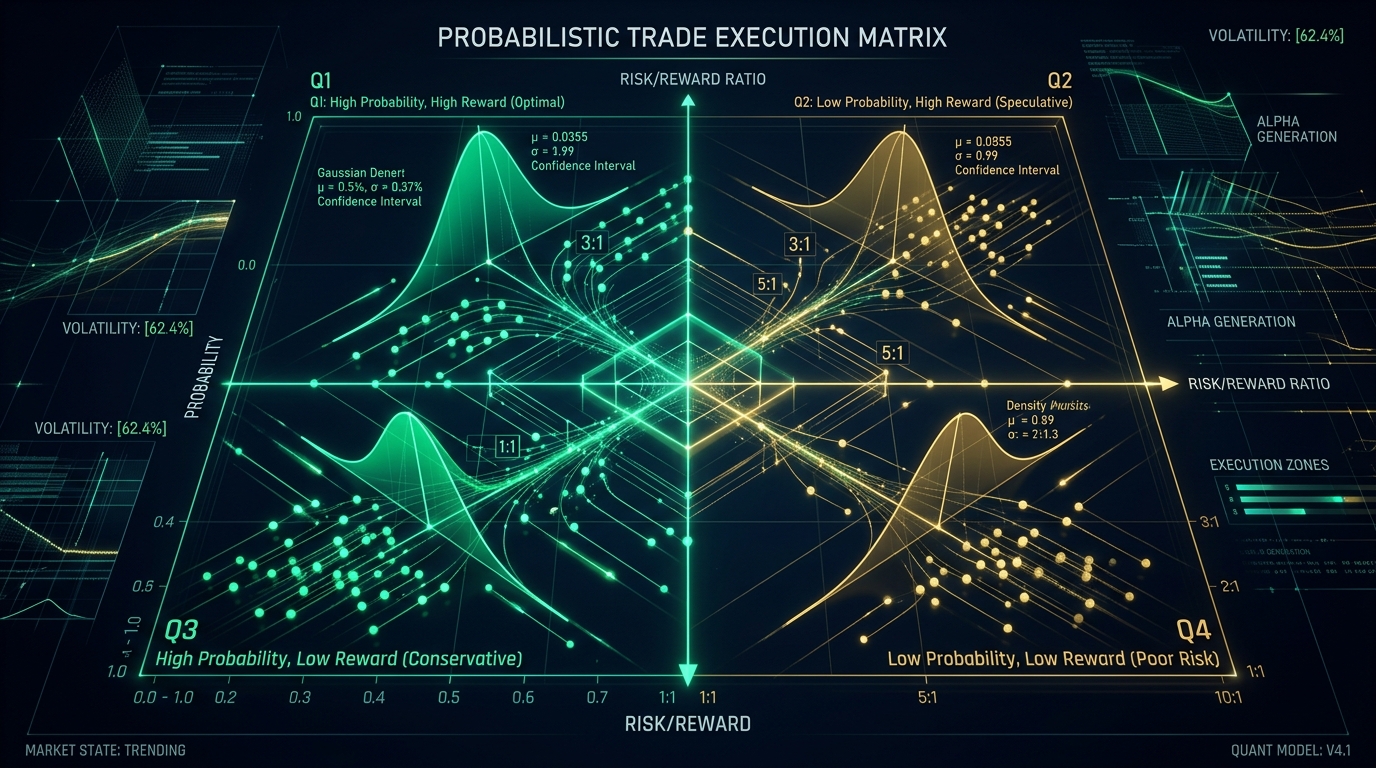
| Quadrant | Execution Behavior | Account Result | Actual Evaluation | Long-term Impact |
|---|---|---|---|---|
| Quadrant 1 (Optimal Trade) | Disciplined plan, verified signal, 1% risk | Profit (Target Reached) | Excellent (Flawless Execution) | Sustainable exponential equity growth |
| Quadrant 2 (Good Loss) | Disciplined plan, verified signal, structural stop-loss | Loss (1% Stop-Loss Hit) | Very Good (Capital Preserved) | Operational business cost, maintain consistency |
| Quadrant 3 (Fatal Trap) | Plan broken, emotional FOMO, reckless leverage | Profit (Lucky Reversal) | Extremely Toxic (Discipline Breach) | Fosters false confidence, inevitable account ruin |
| Quadrant 4 (Suicide Trade) | Revenge trading, no stop-loss, reckless holding | Catastrophic Loss / Account Liquidation | Complete Failure | Forced market exit in despair and panic |
Understanding this 4-Quadrant Matrix reveals a profound truth: A trade in Quadrant 2 (A disciplined loss) is infinitely more valuable than a trade in Quadrant 3 (A reckless win). When executing a proper stop-loss, you did not fail — you flawlessly fulfilled the primary duty of a professional asset manager.
05 THE 4-STEP NEURO-INTERRUPTION PROTOCOL
To prevent the Amygdala from ever hijacking your mouse click after a stop-loss, implement this mandatory 4-step physical neuro-interruption protocol:

Step 1: Disengage From Screens & Practice 4-4-4-4 Box Breathing (Pattern Interrupt)
The moment a stop-loss triggers, immediately stand up and walk away from your desk. Drink a glass of cool water and complete 4 cycles of box breathing: Inhale 4s — Hold 4s — Exhale 4s — Hold Empty 4s. This rhythm forces heart rate deceleration, suppresses adrenal output, and re-oxygenates the prefrontal cortex.
Duration: 5 MinutesStep 2: Enforce A Mandatory Cooling-Off Window
Completely shut down all charting software and trading terminals for a minimum of 45 minutes. If you hit your daily max loss threshold (e.g., 2% of total equity), enforce an absolute shutdown for the rest of the trading day.
Duration: 45 Minutes
Step 3: Post-Mortem Journaling & Execution Audit
Open your trading journal and document answers to 3 written questions:
1. Did the setup satisfy all technical and market condition criteria?
2. Was the stop-loss anchored strictly to structural invalidation levels?
3. Presented with the exact same data again, would you take this trade?
If all three answers are YES, take pride in executing a flawless probability trade.
Step 4: Realigining Stillness & Returning Solely via Automated Signals
Recite the discipline creed: "I am a probabilistic operator. I only execute when objective mathematical conditions converge." Never hunt for discretionary setups manually; return only upon verified algorithmic scanner notifications.
Duration: 5 Minutes06 AUTOMATING DISCIPLINE WITH TECHNOLOGY: ALGORITHMS AS PSYCHOLOGICAL SHIELDS
Human willpower is a finite, depletable cognitive resource. Regardless of how many psychology books you digest or promises you make, raw emotions inevitably falter when confronting real-time market volatility.
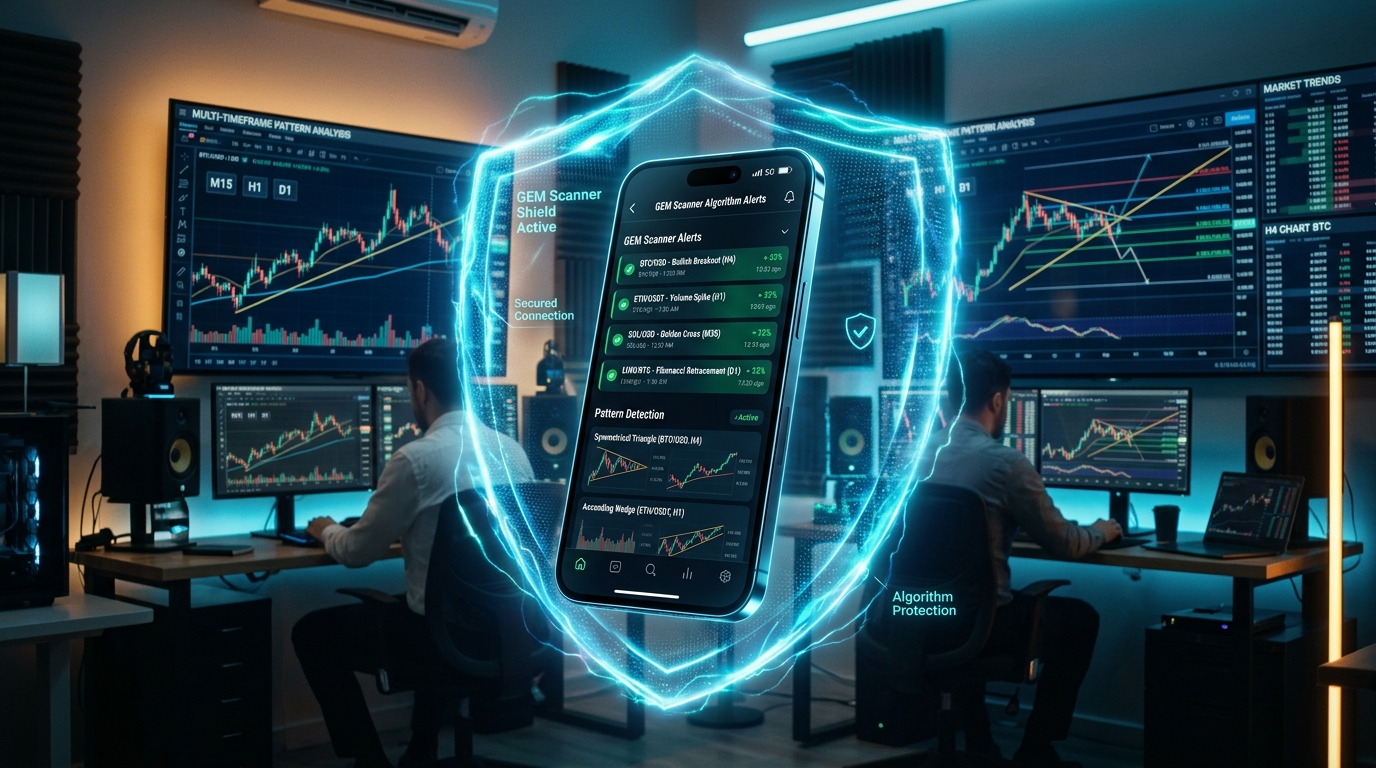
The ultimate edge for modern traders is Delegating Discipline to Technology. Rather than staring at screens for hours and falling into revenge spirals, the GEM Scanner app continuously monitors hundreds of digital asset pairs in real time.
The system dispatches instant alerts only when multi-timeframe market structures fulfill rigorous mathematical probabilities. You eliminate discretionary guesswork, cease candle-watching, and deny the Amygdala any opportunity to trigger impulsive revenge trades.
07 5 INVARIANT PRINCIPLES TO NEVER BLOW UP AN ACCOUNT
1. The Inviolable 1% Risk Rule:
Maximum risk on any single trade must never exceed 1% of total portfolio equity. Under this iron rule, it requires 100 consecutive losses to liquidate your capital — a statistical impossibility in verified positive expectancy systems.
2. The Three-Strikes Daily Shutdown Rule:
If you hit stop-loss 3 consecutive times in a single day, accept that market regime does not align with your model or your emotional state is sub-optimal. Shut down all screens and return refreshed the next day.
3. Anchor Hard Stop-Losses At Position Inception:
Never open a position without an automated hard stop-loss registered on exchange order books. Never widen or move your stop-loss further away as price approaches invalidation.
4. Never Increase Position Size After A Loss:
Martingale averaging down after a loss is the fastest expressway to financial annihilation. Maintain strict, uniform risk parameters across every executed position.
5. Separate Personal Worth From Market Volatility:
You are not your trading PnL. Your inner peace, dignity, and fulfillment remain completely sovereign from fluctuating candlestick movements on a screen.
Revenge trading is a biological reflex: Losses trigger the Amygdala to hijack the prefrontal cortex, pushing you into compulsive gambling to soothe bruised ego.
Disciplined losses are winning executions: Shift focus from being "right or wrong" to operating a probabilistic machine with asymmetric risk-reward ratios.
Strictly execute the 4-step protocol: 4-4-4-4 box breathing, 45-minute terminal cooldown, post-mortem journaling, and returning only in absolute mental stillness.
Automate discipline with technology: Leverage intelligent algorithmic systems like GEM Scanner to eliminate emotional friction and compulsive chart-watching.
Closing Remarks From Jennie Uyen Chu
"In the art of mastering life and financial markets, the most dangerous adversary is never market makers or trillion-dollar algorithms. The greatest opponent lurks within your own proud ego — desperate to prove itself right and refusing to accept a modest operational loss.
The enduring victor in financial markets is always the one who calmly bows before adverse probabilistic outcomes, preserving capital and energy to ride the massive waves of the next market cycle."
Reference Data Sources & Academic Bibliography (22 Sources)
- Daniel Kahneman & Amos Tversky — Prospect Theory: An Analysis of Decision under Risk (Econometrica).
- Daniel Goleman — Emotional Intelligence: Why It Can Matter More Than IQ (Amygdala Hijack Concept).
- Mark Douglas — Trading in the Zone: Master the Market with Confidence, Discipline and a Winning Attitude.
- Antonio Damasio — Descartes' Error: Emotion, Reason, and the Human Brain (Somatic Marker Hypothesis).
- Andrew Lo — Adaptive Markets: Financial Evolution at the Speed of Thought (MIT Laboratory for Financial Engineering).
- Nassim Nicholas Taleb — Fooled by Randomness: The Hidden Role of Chance in Life and in the Markets.
- Robert Greene — The 48 Laws of Power & The Laws of Human Nature (Mastery over reactive emotions).
- Benoit Mandelbrot — The (Mis)Behavior of Markets: A Fractal View of Risk, Ruin, and Returns.
- Brett Steenbarger — The Psychology of Trading & Enhancing Trader Performance.
- David Kahneman — Thinking, Fast and Slow (System 1 vs System 2 cognitive processing).
- B.F. Skinner — Contingencies of Reinforcement: A Theoretical Analysis (Intermittent reinforcement and gambling traps).
- Journal of Behavioral Finance — Cognitive Fatigue and Overtrading in Volatile Digital Asset Environments (2025).
- Stanford Center for Neuroeconomics — Neural Predictors of Financial Risk Taking and Loss Aversion (2025).
- Cambridge Judge Business School — High Cortisol and Irrational Risk Taking Among Financial Traders (2024).
- Robert Sapolsky — Behave: The Biology of Humans at Our Best and Worst (Biochemical impacts of Adrenaline and Cortisol).
- Ray Dalio — Principles: Life and Work (Root-cause error analysis and radical open-mindedness).
- University of Zurich — Neurobiology of Revenge and Punishment in Economic Dilemmas (2025).
- Oxford Man Institute of Quantitative Finance — Algorithmic Risk Bounds vs. Human Discretionary Degradation (2025).
- Michael Mauboussin — The Success Equation: Untangling Skill and Luck in Business and Investing.
- Carol Dweck — Mindset: The New Psychology of Success (Growth mindset vs ego-defensive traps).
- Journal of Neuroscience — Prefrontal Cortex Inhibition during Acute Financial Loss Events (2025).
- GEM Knowledge Vault — GEM Frequency Psychology & Automated Probability Scanning Architecture (2026).
Investment Disclaimer: This publication is compiled exclusively for educational purposes in behavioral psychology and scientific risk management. Content does not constitute financial investment advice or recommendations to trade digital assets. Cryptocurrency markets carry high volatility; investors assume sole responsibility for individual portfolio management decisions.
End The Emotional Storm,
Master Discipline With Automated Scanning Systems!
Do not let short-term losing trades destroy your accumulated capital. Master probabilistic market reading and elite trading psychology with the GEM Starter course.
Combine with the GEM Scanner app to automate 100% of your signal detection, freeing you from compulsive chart-watching.