Emotional Position Sizing: Why Your Biggest Trade Is Always Your Worst Trade & Quantitative Capital Matrix
EMOTIONAL POSITION SIZING:
Why Your Biggest Trade Is Always Your Worst?
Dissecting the neurobiological mechanisms of the Amygdala, decoding ruin probability mathematics, and establishing the GEM Frequency 4-Tier Position Sizing Matrix to preserve sustainable edge.
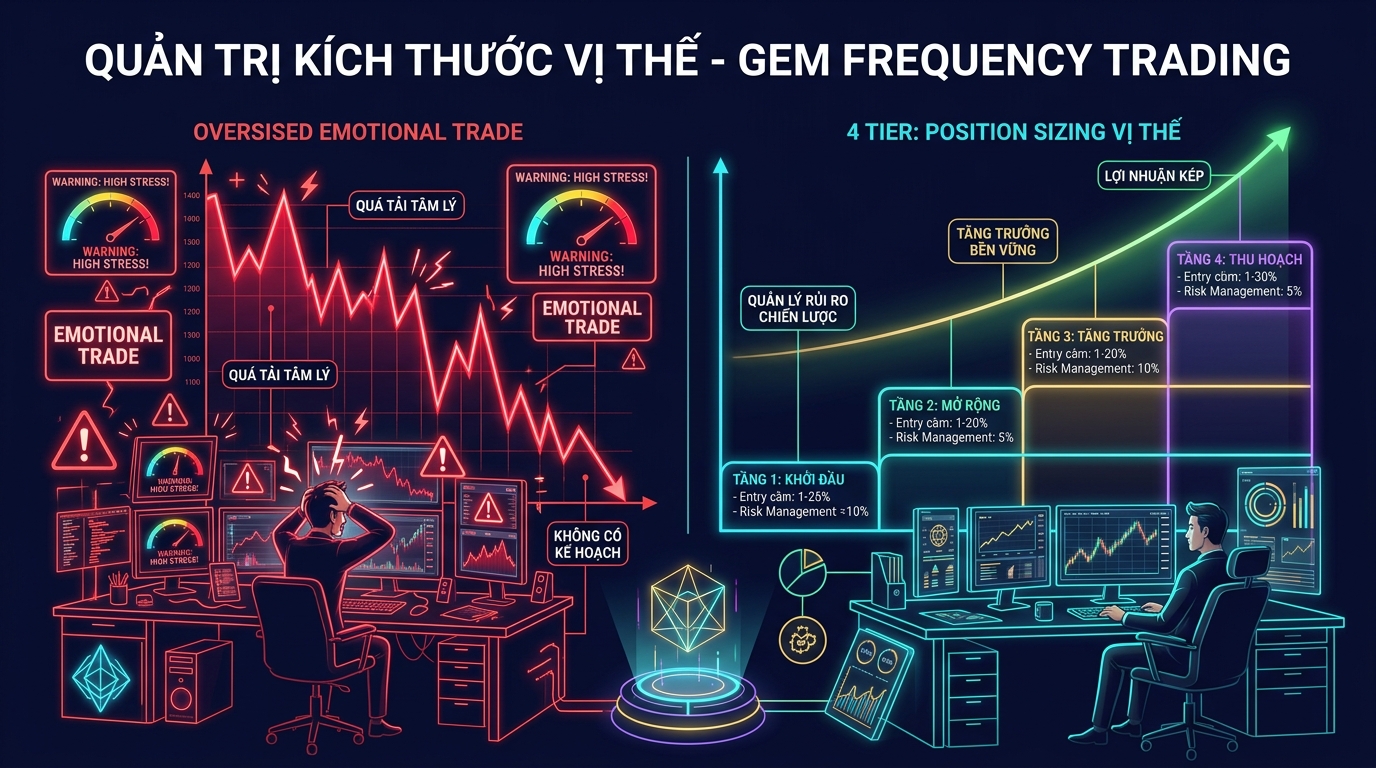
01 THE ALL-IN MOMENT: THE $45,000 COLLAPSE AFTER A RECORD WINNING STREAK
Minh was a remarkably disciplined cryptocurrency trader. For 90 consecutive days, he rigorously adhered to his system, risking strictly 1% per setup ($50 on a $5,000 account). With a 62% win rate and 2:1 average R:R, his capital compounded steadily from $5,000 to an impressive $50,000. Community peers admired him as a paragon of stoic discipline.
Yet tragedy unfolded on a Friday night. Following a 6-trade winning streak, Minh spotted a flawless reversal pattern on the Bitcoin 4H chart. Technical indicators, on-chain flows, and sentiment all converged bullishly. A surge of euphoric certainty overwhelmed his judgment: "This is a once-in-a-lifetime home run setup. Guaranteed 100% win. Risking only 1% wastes this incredible edge!"
Instead of his standard $500 position, Minh impulsively deployed $30,000 on 10x leverage, rationalizing: "A mere 3% move will double my equity to $100,000." But financial markets relentlessly punish hubris. A sudden macroeconomic announcement at 2 AM caused Bitcoin to flash-wick down 4% before rebounding. The 12-minute liquidity sweep triggered forced liquidation, incinerating $45,000 of accumulated 3-month profits in the blink of an eye.
02 THE DOPAMINE TRAP & ILLUSION OF CERTAINTY

Why can a trader maintain discipline across hundreds of setups only to blindside themselves on their largest trade? The answer lies in the primitive neurobiological architecture of the human brain.
During a consecutive winning streak, the brain releases large surges of Dopamine — the neurotransmitter of reward and arousal. Behavioral scientists term this the Hot-Hand Fallacy. The brain constructs a dangerous illusion: conflating short-term probabilistic luck with personal predictive genius.
At peak Dopamine, risk evaluation pathways are inhibited. You no longer perceive a trade as an independent probabilistic trial. Instead, you hallucinate "absolute certainty". You scale position size 5x, 10x, or go all-in. The sobering reality is: the market does not know your past win record. Every new trade is an entirely independent statistical trial, and reckless sizing is walking straight into the lion's den.
03 COGNITIVE PARALYSIS: WHEN AMYGDALA HIJACKS PREFRONTAL CORTEX
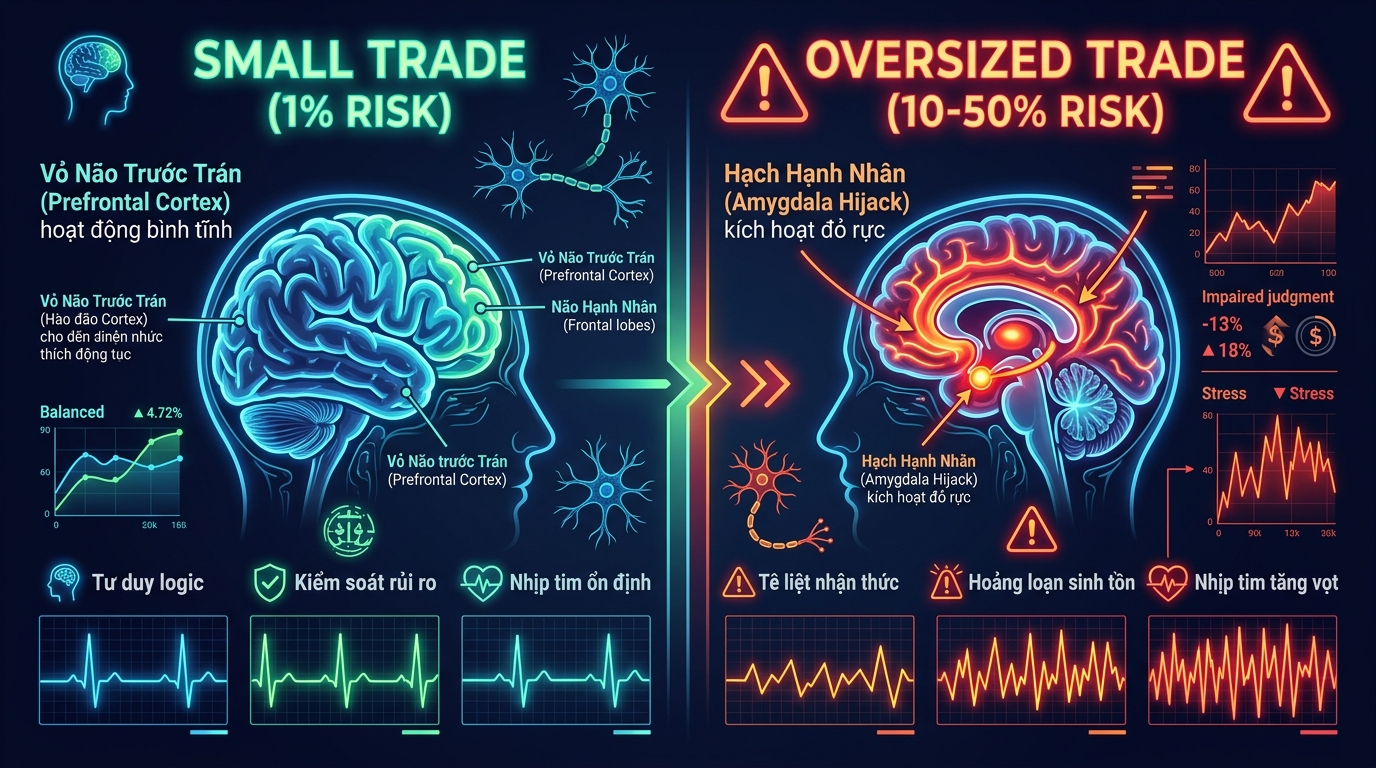
What actually occurs inside your nervous system when holding an oversized position moving against you?
When risking 1% of equity, maximum potential loss remains small and fully tolerable. The Prefrontal Cortex — seat of logic, probability calculation, and discipline — retains complete executive control. Heart rate remains steady, breathing rhythmic, and invalidation is accepted calmly as an ordinary business cost.
However, when risking 20%, 30%, or 50% of equity, potential drawdown directly threatens personal financial survival. The brain equates the paper loss to an acute physical survival threat. The Amygdala sounds a red alert (Amygdala Hijack), triggering Fight-or-Flight reflexes. Heart rate spikes, blood pressure surges, and the prefrontal cortex is effectively throttled.
In this cognitively impaired state, you cease to be a rational analyst and become a panicked gambler: you freeze and avoid executing stop-losses to dodge the agony of massive loss, pray in despair, widen stops, and watch your capital vaporize. Your biggest trade becomes your worst because oversized leverage triggers biological panic circuitry, annihilating probabilistic reasoning.
04 4 COMMON EMOTIONAL POSITION SIZING TRAPS
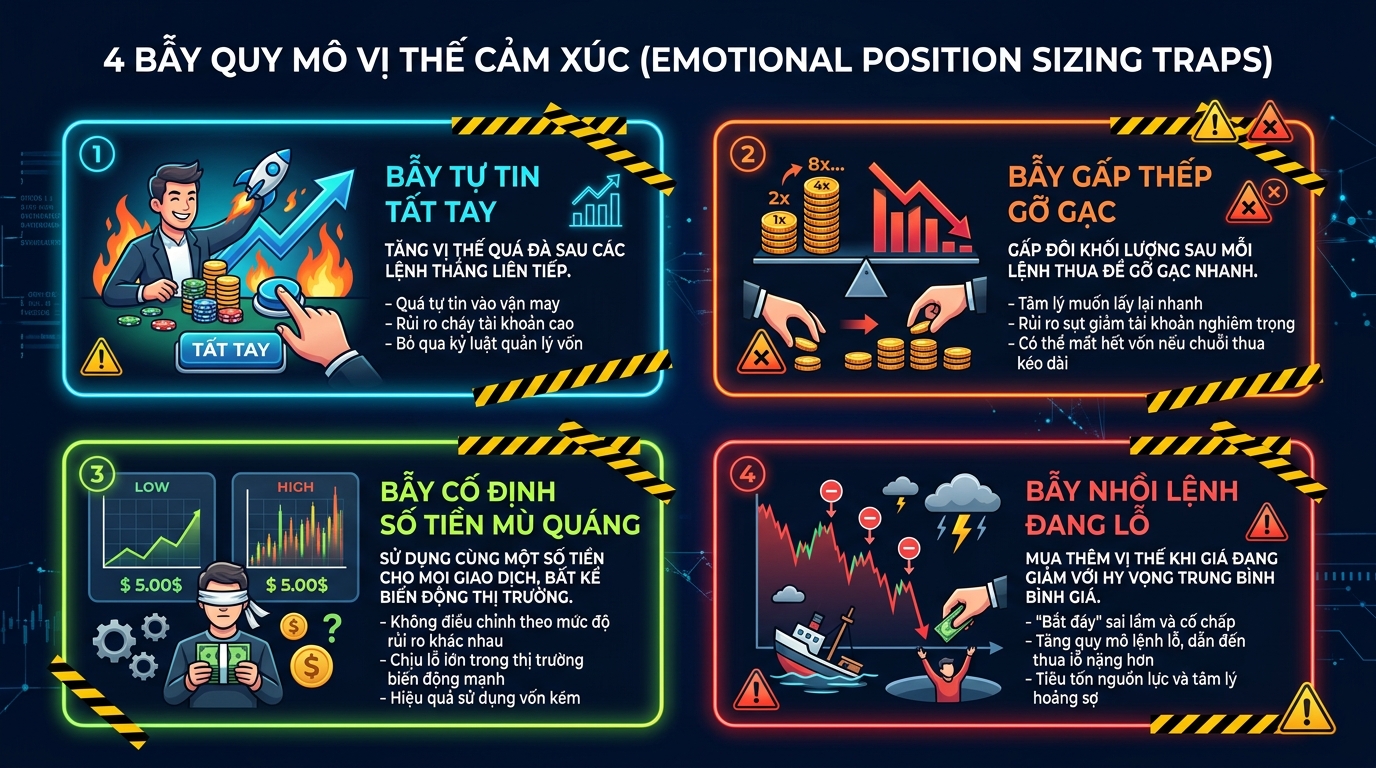
To protect capital, you must first diagnose the 4 insidious psychological traps:
Hot-Hand All-In
Aggressively scaling position size after a winning streak believing you are invincible. Result: 1 single loss wipes out dozens of previous winning setups.
Martingale Revenge Oversizing
Doubling size immediately after getting stopped out to recover deficits in one move. This is the fastest route to account exhaustion after 3-4 consecutive losses.
Blind Fixed Dollar Sizing
Deploying identical dollar sizing across every asset without factoring Average True Range (ATR) or stop-loss distance. Trading a 30%/day volatility token identically to a 2%/day coin causes catastrophic risk loss.
Averaging Down Losing Trades
Adding size as price plunges to lower average entry price. Instead of cutting invalid setups, stubborn traders turn a manageable paper loss into an account-crushing leviathan.
05 THE BRUTAL MATHEMATICS OF RUIN PROBABILITY (RISK OF RUIN)
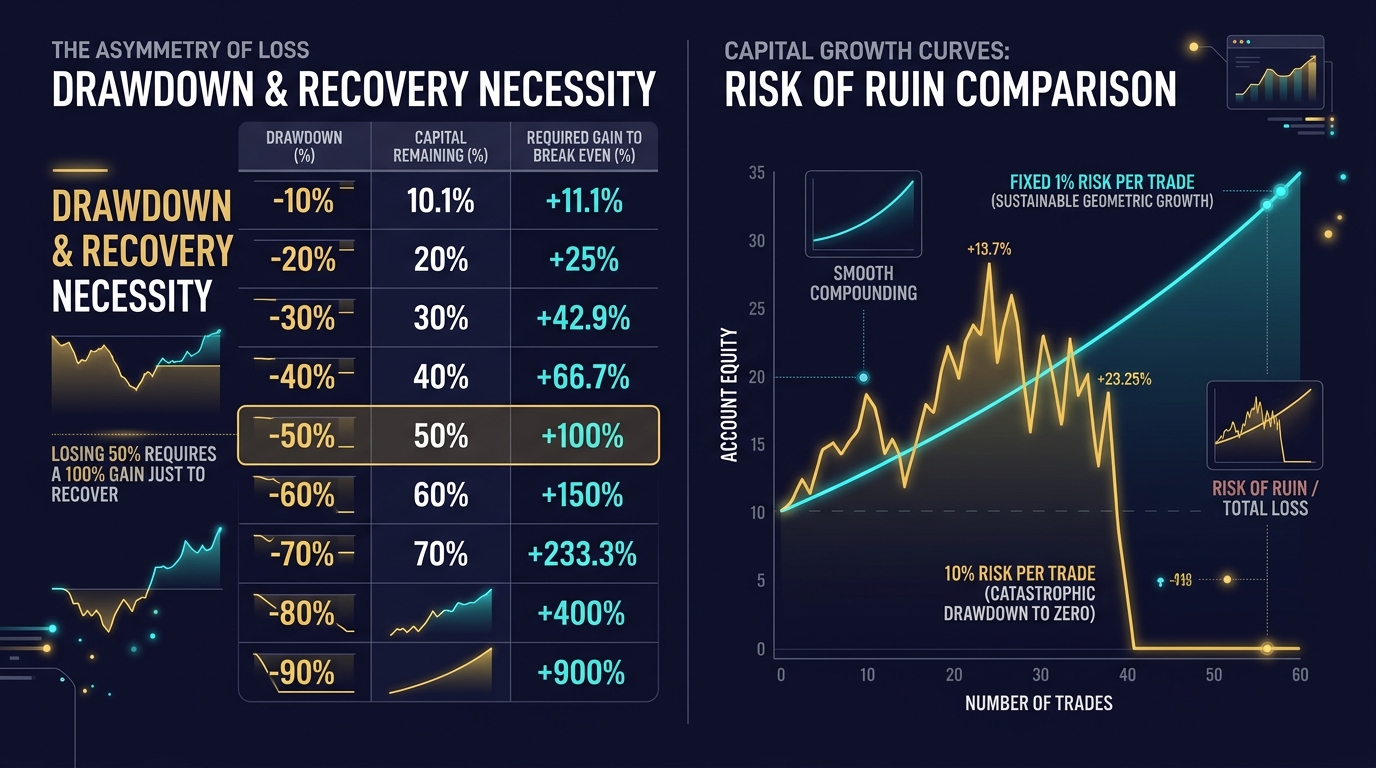
Many enter the market assuming a 50% loss requires a 50% gain to breakeven. This fundamental mathematical fallacy has destroyed millions of traders.
Observe the asymmetric mathematics of equity recovery:
| Account Drawdown Level | Remaining Equity | Gain Required To Breakeven |
|---|---|---|
| -10% | 90% | +11.1% |
| -20% | 80% | +25.0% |
| -30% | 70% | +42.9% |
| -50% | 50% | +100.0% |
| -80% | 20% | +400.0% |
| -90% | 10% | +900.0% |
When risking 1% equity per setup, even a 10-trade losing streak (entirely normal in random distribution) reduces equity by merely 9.5%. You need a modest +10.5% gain to restore peak capital — an easily achievable target.
However, risking 10% per trade atrophies over 40% equity in 5 losses. To breakeven, you must generate nearly +70%. Crushing psychological pressure distorts rational execution, driving you toward reckless gambling and total liquidation.
06 THE GEM FREQUENCY 4-TIER POSITION SIZING MATRIX
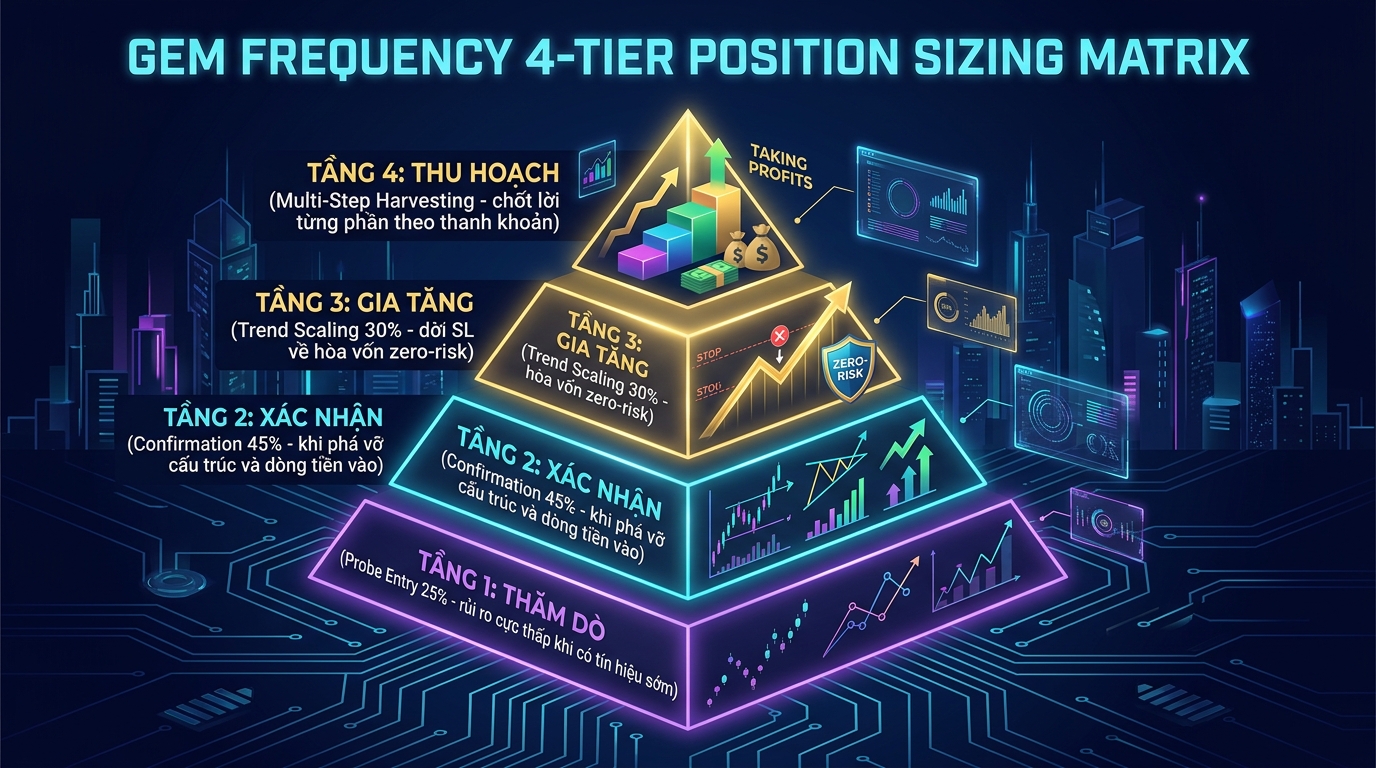
To escape the all-in trap, the GEM Frequency framework standardizes capital allocation into 4 disciplined, hierarchical tiers:
Tier 1: Probe Entry (25% Sizing)
Activated on early reversal signals at key structural support/resistance. With 25% sizing, invalidation is small and psychological impact negligible.
Tier 2: Confirmation Entry (45% Sizing)
Deployed when price confirms a Break of Structure with Smart Money Volume surges, significantly increasing win probability.
Tier 3: Trend Scaling (30% Sizing)
Activated only upon successful pullback retest confirming trend continuation. Mandatory Condition: Stop-losses for Tiers 1 and 2 must already be trailed to Breakeven, locking in a Zero-Risk Trade.
Tier 4: Multi-Step Harvesting (Phased Profit Taking)
Never add leverage when price stretches into overbought/oversold extremes. Instead, scale out: 40% at TP1, 30% at TP2, and trail 30% along the trendline.
07 5-STEP DAILY QUANTITATIVE POSITION SIZING

To permanently decouple emotion from execution, follow this rigid 5-step workflow:
- Step 1 — Define Structural Stop-Loss First: Locate technical invalidation based on chart structure (Swing Low/High or FVG); never enter without knowing your exact stop level.
- Step 2 — Fix Exact Dollar Risk (1R): Define exact dollar risk per trade (e.g., 1% of total account = $100).
-
Step 3 — Compute Nominal Size via Formula: Apply standard formula:
Position Size = Dollar Risk / Stop-loss Distance. Wider stops automatically reduce size; tighter stops increase size, keeping dollar risk strictly at 1R. - Step 4 — Execute Bracket Order with Hard Stop: Place automated stop-loss upon entry. When price reaches 1.5R or 2R, trail stop to breakeven to eliminate risk.
- Step 5 — Log in Trade Journal: Record rationale, expected R:R ratio, and pre-trade psychological state to continuously refine discipline.
08 ROBERT GREENE PERSPECTIVE: MASTERING EMOTION & SUSTAINED COMPOUNDING

In The 33 Strategies of War, Robert Greene observes: "The greatest defeat of a general never comes from the strength of the enemy, but from the moment he is intoxicated by victory, placing his entire army in a battlefield with no retreat."
Financial markets represent an uncompromising psychological arena, continuously transferring wealth from impatient seekers of instant riches to disciplined grandmasters. The distinction between a gambler and a master trader is simple: amateurs seek euphoric stimulation from outsized bets; masters seek the boredom of executing flawless discipline thousands of times.
When you master position sizing, you master your inner state. Unshackled from greed and fear, enduring wealth compounds naturally as an inevitable consequence.
CORE LESSON SUMMARY (KEY TAKEAWAYS)
- Your biggest trade is almost always your worst: Dopamine euphoria after a winning streak misleads you into confusing probability with certainty, triggering ruinous all-in blowouts.
- Amygdala Hijack Phenomenon: When risking excessive capital, the brain enters survival panic, completely paralyzing prefrontal cortex executive reasoning.
- Asymmetric Loss Mathematics: A 50% loss requires +100% to breakeven. Fixed 1% - 1.5% risk per trade is your sole mathematical shield against ruin probability.
- GEM Frequency 4-Tier Matrix: Scale position size only when setups are profitable with stops trailed to Breakeven (Zero-Risk Trade); never add to losing positions.
SCIENTIFIC CITATIONS & RESEARCH REFERENCES (20 SOURCES)
This article is compiled by the GEMRAL research team for psychological analysis and quantitative capital allocation education. Contents do not constitute financial advice. Cryptocurrency markets involve high volatility risk; investors bear sole responsibility for their personal sizing and risk decisions.
Master Position Sizing Precision,
Eliminate Emotional Trading Forever!
Equip yourself with quantitative financial discipline via GEM Trading Starter, combined with 24/7 automated pattern recognition and stop-loss alerts from GEM Scanner.

GEM Trading Starter
Master position sizing algorithms, structural invalidation stops, and probabilistic execution of professional traders.

GEM Scanner App
Algorithmic radar scanning technical patterns and unusual liquidity anomalies 24/7 with real-time mobile alerts.

7 Days To Unleash Root Frequency
Heal financial anxiety, release limiting beliefs, and cultivate serene grounded frequency amidst market volatility.