The Frequency of a Decision: Why Your Inner State at the Moment of Execution Dictates 90% of Results
The Frequency of a Decision: Why Your Inner State at the Moment of Execution Dictates 90% of Results
Most traders believe they fail because they lack a magic technical indicator or have not memorized enough candlestick patterns. Modern neuroscience proves the exact opposite: Your clicking finger is merely a biological conduit for the hormonal surge, heart rate rhythm, and inner vibrational frequency reverberating within your body.
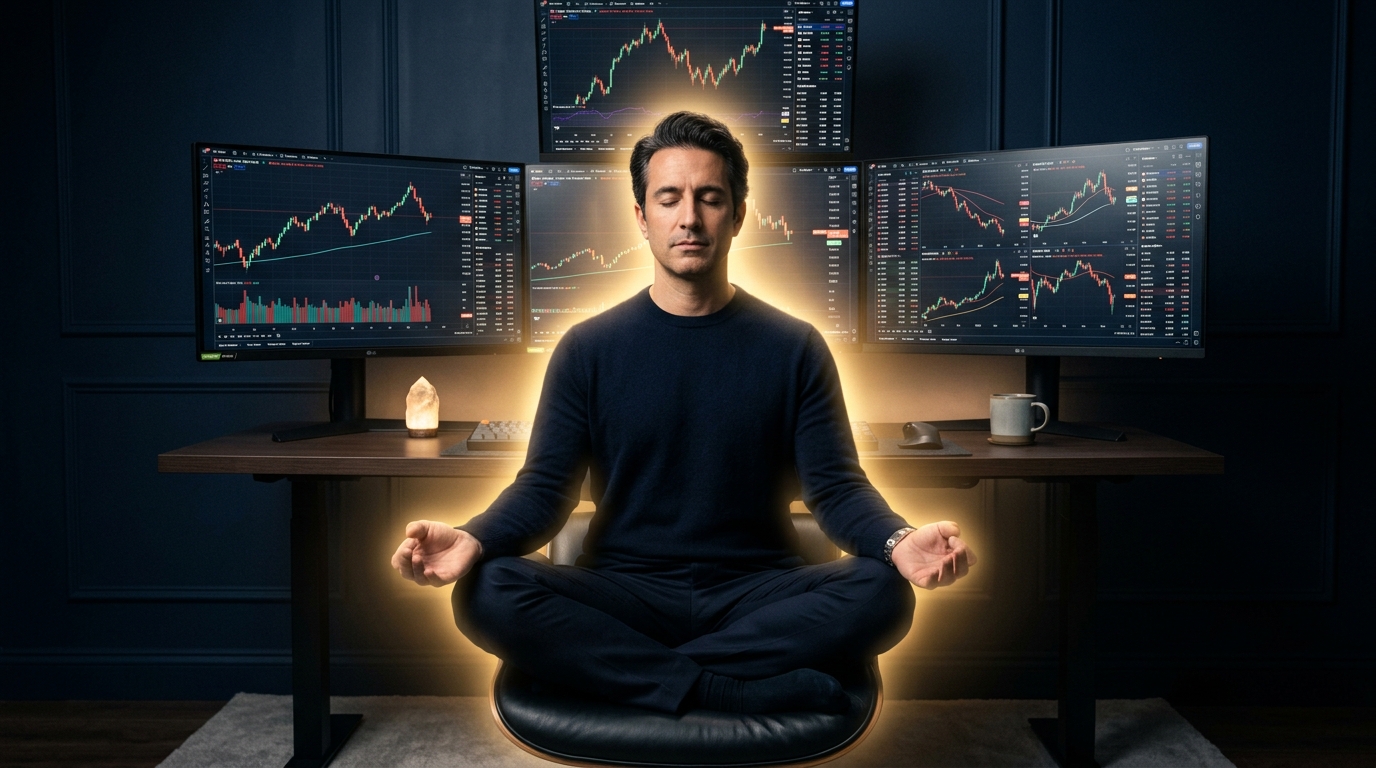
Inner stillness is the ultimate weapon separating professional market operators from the impulsive crowd. (Click to expand)
Table of Contents
- 01. The 2:00 AM Moment: Anatomy of a Self-Destructive Click
- 02. Cognitive Paradox: Why Elite Chart Analysts Still Blow Up Accounts
- 03. Neurobiological Evidence: Heart Rate Variability & Hormonal Storms
- 04. The 3 Tiers of Trading Consciousness Frequency
- 05. The Cost of Turbulence: Two Destinies on the Same Price Chart
- 06. The 4-Step Pre-Flight Frequency Calibration Protocol
- 07. The Immutable Maxim & Core Practical Takeaways
The 2:00 AM Moment: Anatomy of a Self-Destructive Click
Be utterly honest with yourself about this exact moment: A pitch-black room, the harsh blue luminescence of trading screens illuminating a strained, sleep-deprived face. The clock reads 02:15 AM.
You have just survived an exhausting corporate day, carrying unresolved resentment over unexpected expenses. On the 5-minute chart, Bitcoin suddenly prints a massive vertical green candle ripping through the upper resistance band. Your heart begins thumping erratically at 115 BPM. Your throat constricts, cold sweat slicks your palms, and a frantic voice screams in your subconscious: "Enter now or you will miss the move! If you don't take this candle, you can never recover yesterday's losses!".
Barely ten minutes later, that euphoric green candle leaves a vicious liquidity sweep wick and collapses into a free fall. You freeze in cognitive paralysis, refusing to execute your stop loss, adding margin to a losing position in despair, and watching your account evaporate as dawn breaks.
This tragic sequence is not bad luck. It is the inevitable manifestation of a universal law ignored by 99% of market participants: The inner vibrational frequency you embody at the exact microsecond of clicking execution has already determined the outcome before your order ever reaches the exchange matching engine.
Cognitive Paradox: Why Elite Chart Analysts Still Blow Up Accounts
In his classic masterpiece "Trading in the Zone", legendary trading psychologist Mark Douglas illuminated a ruthless paradox: Countless brilliant technical analysts can forecast price trajectory with over 70% historical accuracy in retrospective reviews, yet consistently hemorrhage capital when executing live funds.
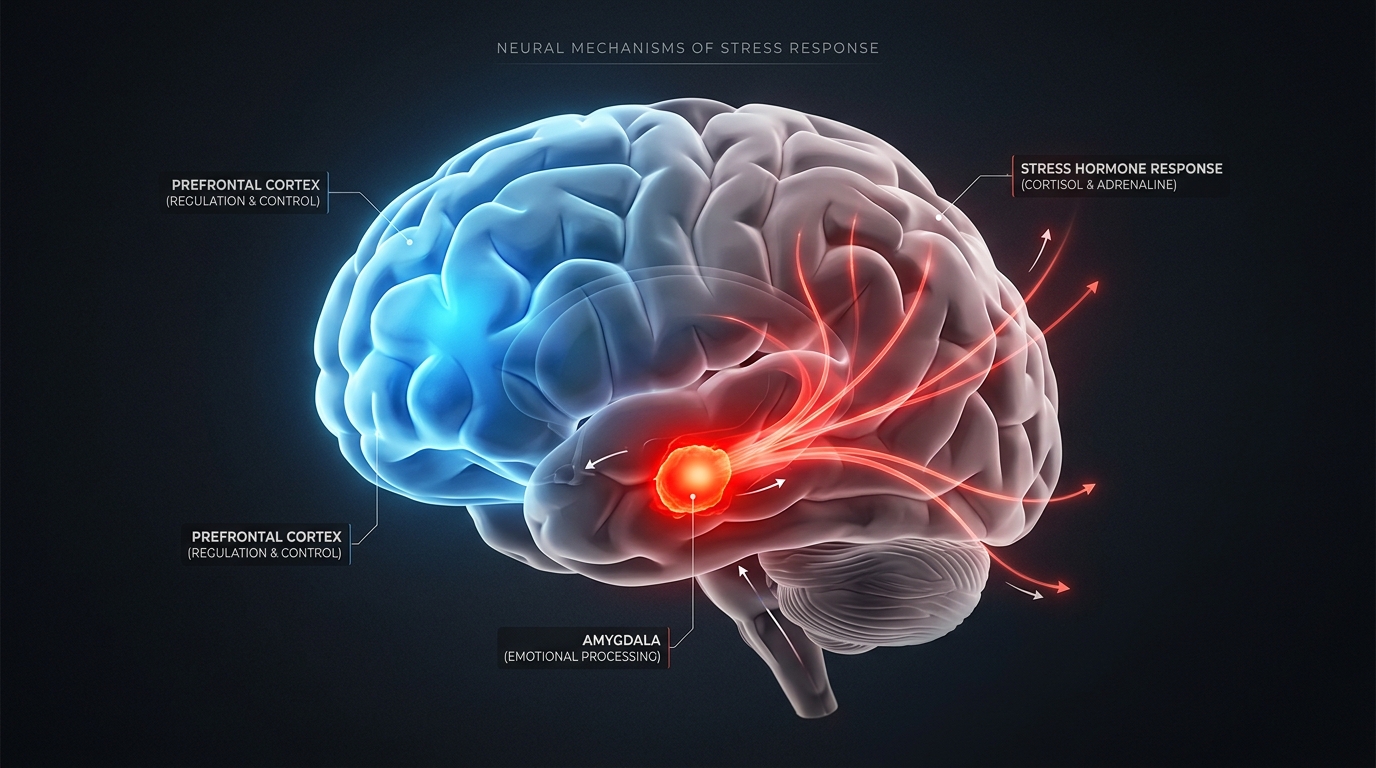
When financial threat emerges, the Amygdala instantly hijacks the Prefrontal Cortex, regressing human cognition into primitive survival reflexes.
Neuroeconomist Antonio Damasio (University of Southern California) demystified this phenomenon through his groundbreaking Somatic Marker Hypothesis. Damasio demonstrated that the human brain is not an abstract logical computer. Long before the Prefrontal Cortex can process mathematical probabilities, the Limbic System and physical body fire visceral somatic signals: elevated heart rates, muscular constriction, and chest tightness.
The chasm between intellectual theory and biological reality is glaring:
"I entered because I identified a confirmed double bottom pattern with volume confirmation and a strict 1:3 Risk-to-Reward ratio according to systematic capital rules."
You stared at inactive screens for four fruitless hours. Feeling unproductive and agitated, your brain fabricated phantom patterns simply to justify clicking and relieving restless somatic tension.
When you execute from a state of internal scarcity and anxiety, you are not trading the market; you are utilizing financial markets as an emotional casino to satisfy visceral biological addictions.
Neurobiological Evidence: Heart Rate Variability & Hormonal Storms
The concept of "Trading Frequency" is not esoteric mysticism. In premier neuroeconomics laboratories, this energetic state is measured precisely through empirical biometrics.
In 2002, Professor Andrew Lo and Dr. Dmitry Repin at the Massachusetts Institute of Technology (MIT) conducted a seminal experiment: Attaching real-time biometric sensors to active hedge fund and prop traders in Boston during live market hours.
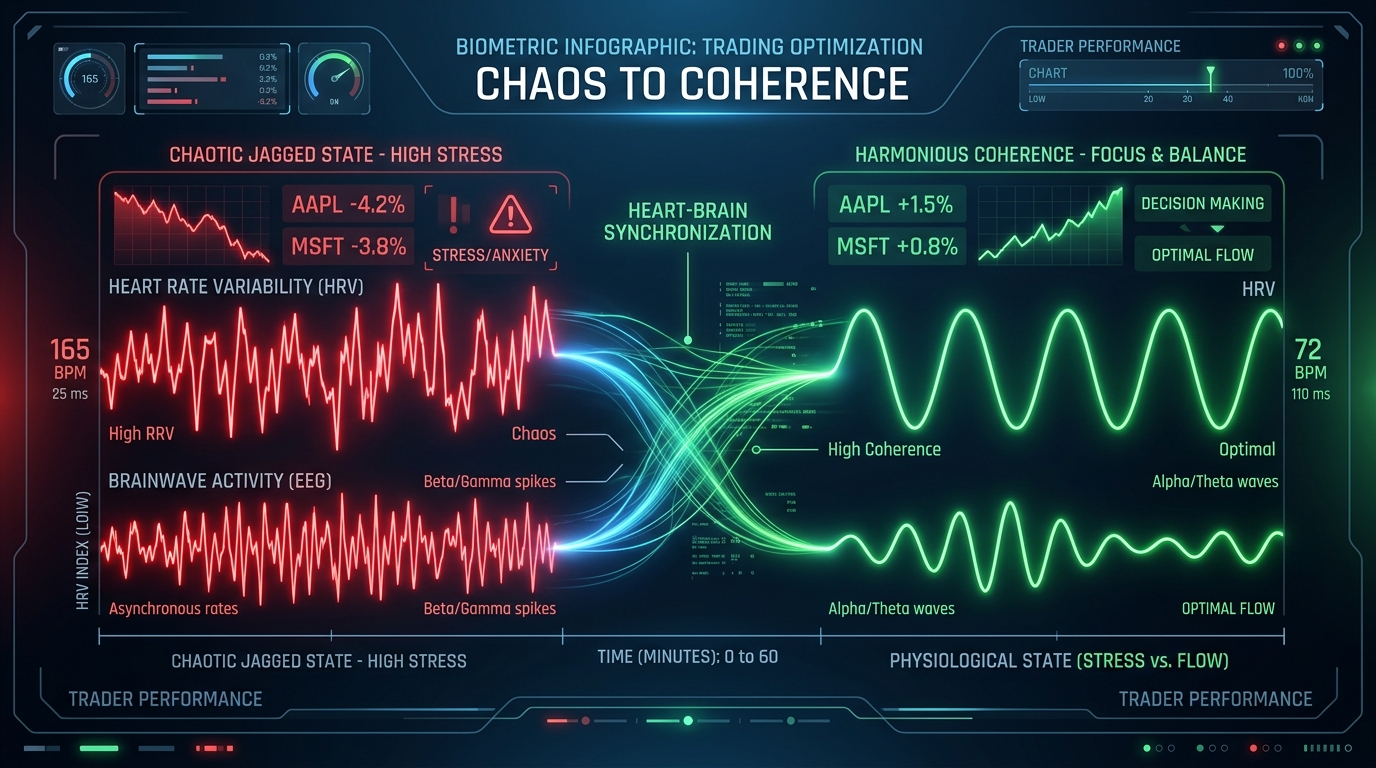
MIT research by Andrew Lo confirms: Veteran master traders maintain coherent High-Frequency Heart Rate Variability (HF HRV), remaining physiologically untethered to short-term market noise.
Their findings revealed stark physiological divergence:
- Novice Operators: Electrodermal activity (EDA) and cardiovascular rhythms fluctuated wildly with every single tick of price data. Chronic sympathetic nervous system arousal crashed their High-Frequency Heart Rate Variability (HF HRV), dragging them into physiological chaos and panic-driven execution.
- Master Operators: Maintained high cardiac coherence and stabilized resting heart rates even during severe flash crashes. This somatic self-regulation represents their ultimate competitive moat.
Extending these findings, Professor John Coates (University of Cambridge) — former Wall Street derivatives trader — published landmark research in PNAS and author of "The Hour Between Dog and Wolf", deciphering two critical biochemical drivers:
1. Testosterone & The "Winner Effect" Delusion
Following 3-4 consecutive winning trades, systemic testosterone surges. This hormone induces intense euphoria while paralyzing objective risk assessment. You begin dismissing trade rules, multiplying position sizes under the delusional belief that you have "decoded market dynamics". This marks the beginning of catastrophic ruin.
2. Cortisol & Chronic Stress Paralysis
Conversely, following painful drawdowns or prolonged drawdown holding, elevated cortisol constricts cerebral microcirculation. You enter cognitive paralysis: When valid high-probability setups appear, you hesitate in fear; yet when price reverses slightly, you prematurely harvest tiny 0.5R profits due to terror of loss.
When systemic hormones oscillate between these destructive extremes, every written trade plan is rendered obsolete. You cannot execute clarity from a physiology poisoned by autonomic distress.
The 3 Tiers of Trading Consciousness Frequency
Synthesizing Dr. David Hawkins' Map of Consciousness and the empirical wisdom of the GEM Frequency Methodology, a trader's internal operational state falls into three distinct vibrational tiers:
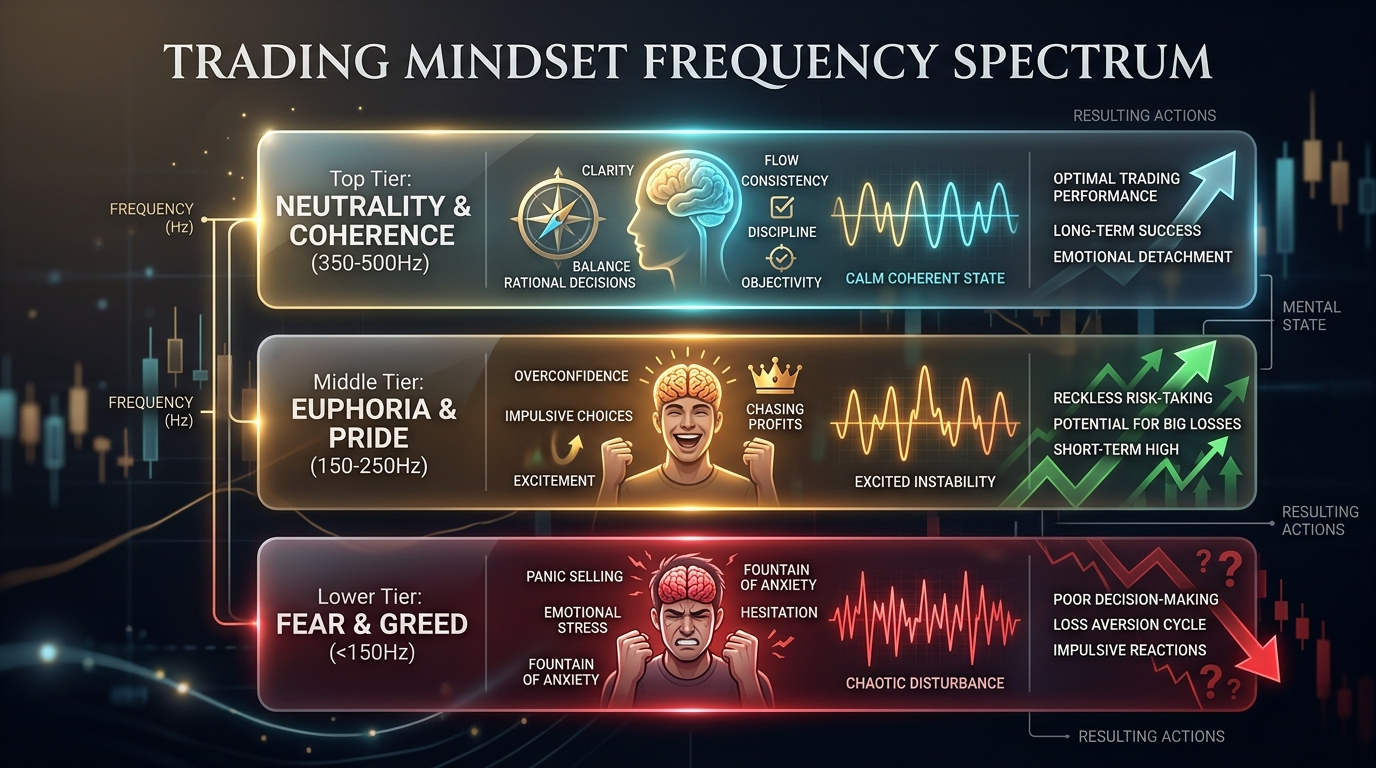
The Consciousness Frequency Spectrum in Execution: From Lower Scarcity (Under 150Hz) to Egoic Euphoria (150-250Hz) and Sovereign Neutral Coherence (350-500Hz).
Fear, Resentment & Revenge Trading
Somatic Symptoms: Shallow thoracic breathing, clenched jaw, contracted trapezius muscles, eye strain, erratic pulse.
Execution Drivers: Fear of Missing Out (FOMO), acute financial scarcity, or furious urgency to "avenge" a previous loss.
Reckless Optimism & Risk Blindness
Somatic Symptoms: Hyperactivity, restless physical energy, grandiose verbalization, artificial rush of adrenaline.
Execution Drivers: Believing one is a "gifted market prophet", dismissing disciplined risk models as unnecessary constraints.
Serene Objectivity & Probabilistic Acceptance
Somatic Symptoms: Deep diaphragmatic respiration, full muscular relaxation coupled with razor-sharp cognitive vigilance, rhythmic cardiac flow.
Execution Drivers: Identifying an objective High-Probability Setup aligned 100% with empirical rules. Zero emotional attachment to individual trade outcome.
The Cost of Turbulence: Two Destinies on the Same Price Chart
To illustrate the tangible divergence of operational frequencies, consider two real-world traders observing the EUR/USD pair during high-impact volatility:

Identical price charts, identical macro environment: Your internal energetic frequency dictates whether you harvest alpha or become exit liquidity for institutions.
Minh logged into his terminal at midnight following an intense domestic dispute. Seeing aggressive red bars, he panicked about missed profits and shorted the bottom. When price pulled back 15 pips, panic seized him and he manually closed at a loss.
Seconds later, price resumed its downward cascade. Furious, Minh re-entered with 50x leverage to recoup capital. Result: A sharp wick liquidated his account right before the true trend unfolded.
Lam opened his session after 10 minutes of breath calibration and warm tea. Consulting GEM Scanner, he recognized price approaching a 4H Fresh Supply Zone without premature entry confirmation.
He patiently waited for liquidity sweep completion and textbook candle reversal confirmation. Lam queued a Limit Sell with a strict 1% capital risk ($100), placed stops above the swing high, set a 3R Take Profit, and shut his workstation.
The greatest cost of low-frequency trading is not merely financial drawdown. The true catastrophe is Neural Pathway Degradation. Every time you break discipline and accidentally profit from reckless execution, your brain hardwires a toxic cognitive falsehood: "Violating rules yields rewards." That delusion is the hidden fuse to total career ruin.
The 4-Step Pre-Flight Frequency Calibration Protocol
How does an operator systematically transition internal physiology from Tier 1 (Scarcity) to Tier 3 (Coherence)? Implement this strict 4-Step Pre-Flight Frequency Protocol before touching any execution interface:
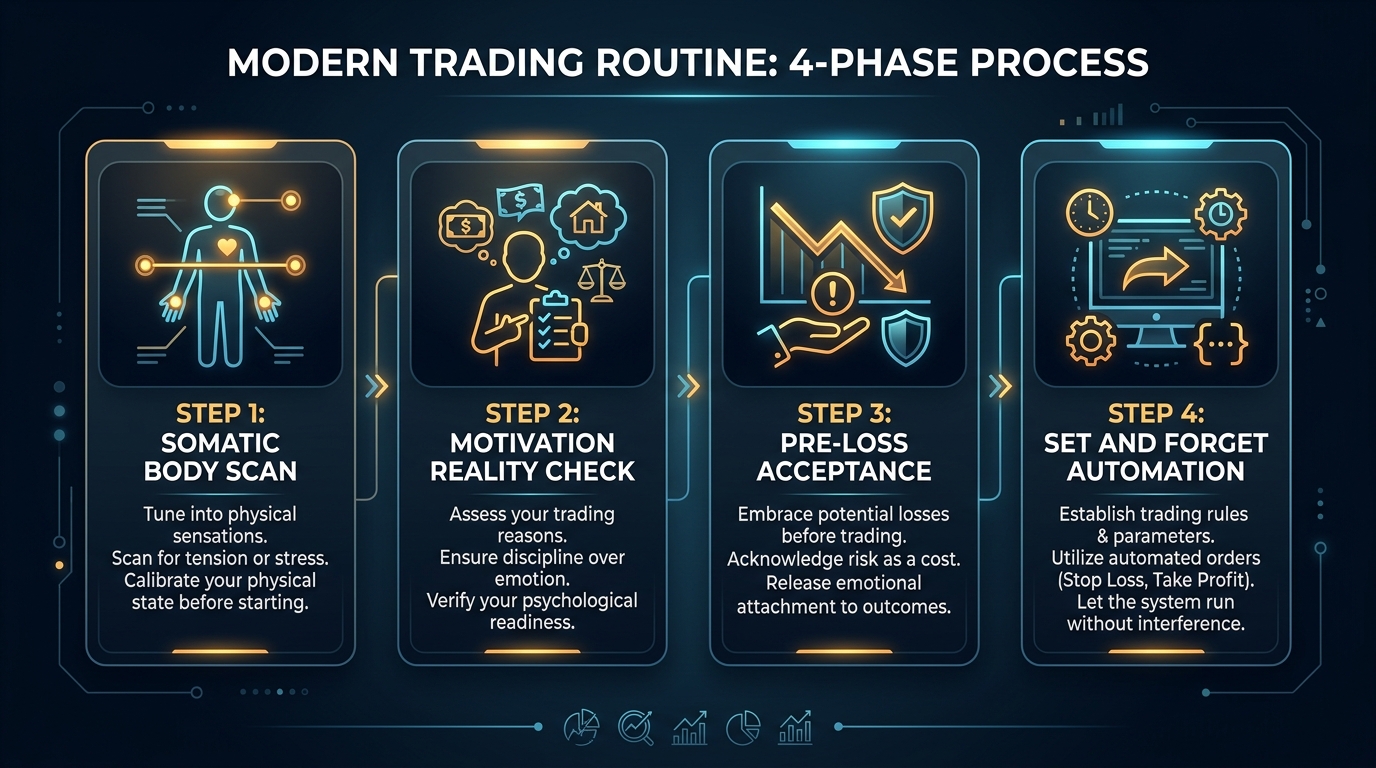
Standardized 4-phase protocol to cleanse psychological noise and unlock optimal execution coherence.
Step 1: Somatic Body Scan & Vagal Regulation (60 Seconds)
Before opening chart interfaces, close your eyes: Unclench your jaw, drop your shoulders, release abdominal tension. Complete four rounds of 4-7-8 breathing (Inhale 4s through nose, hold 7s, exhale 8s through mouth). This directly stimulates the Vagus Nerve, lowering heart rate and inducing calm Alpha brainwave states.
Step 2: Motivation Reality Check
Ask yourself with ruthless authenticity: "If the market provides no valid setups today and I execute zero trades, will I feel agitated, restless, or unproductive?". If the answer is YES, you are suffering from action addiction. Immediately step away from your workstation.
Step 3: Pre-Loss Total Acceptance
Before calculating potential profit targets, examine your stop loss distance and the dollar amount at risk (e.g., $50). Close your eyes and visualize that $50 as PERMANENTLY GONE from your balance. If you remain entirely peaceful, regarding that $50 as a necessary operational cost of business, you possess the energetic permission to execute.
Step 4: Systematic Set & Forget Automation
Utilize objective filtering tools such as GEM Scanner PRO to identify validated Fresh Zones and algorithmic setups. Once entry orders, Stop Loss, and Take Profit are committed to the exchange, close your charts. Never micro-manage 1-minute candles, as chart addiction will drag your autonomic nervous system back into survival panic.
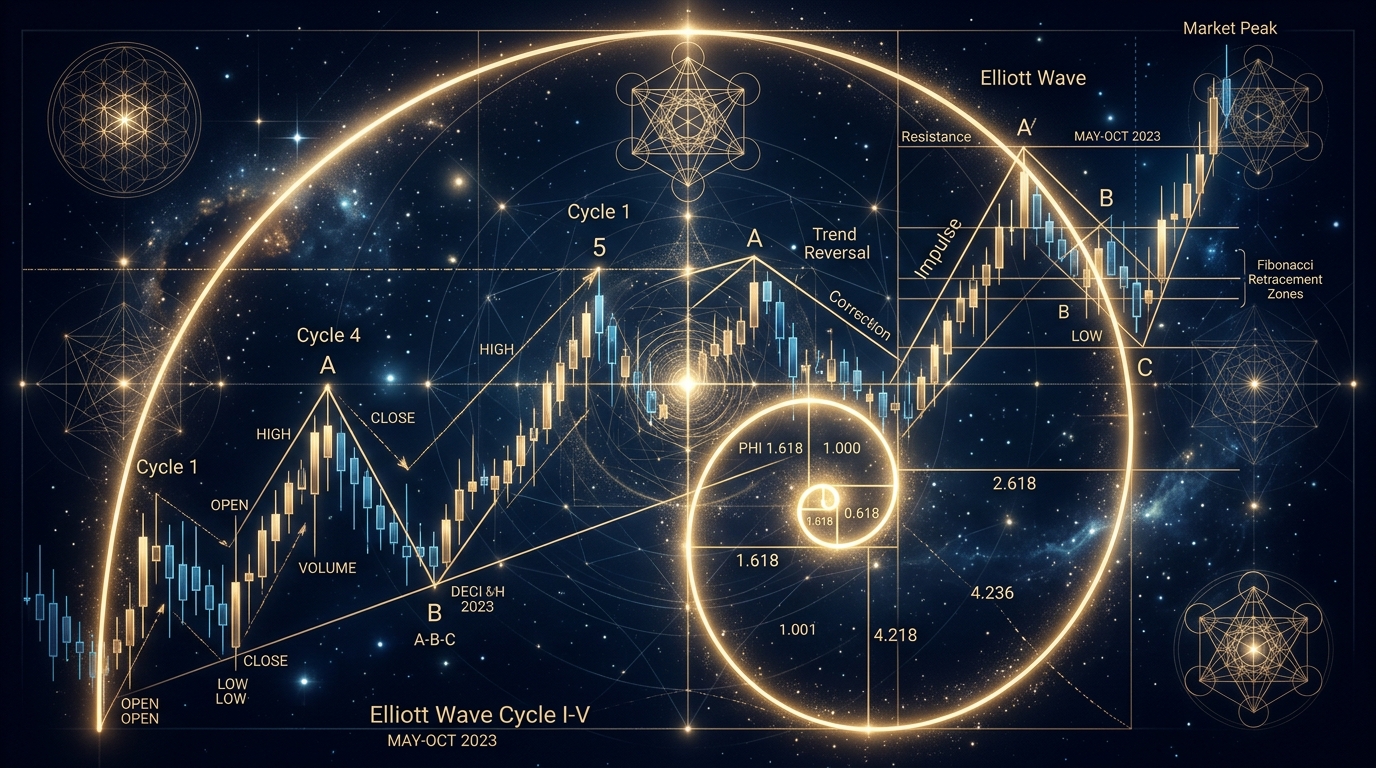
When harmonic frequency coherence is attained, the operator ceases fighting market dynamics and effortlessly flows with the sovereign current of global liquidity.
The Immutable Maxim & Core Practical Takeaways

The eternal mirror law of financial markets.
"Financial markets are the most unforgiving mirror on earth. They never pay for academic diplomas, raw IQ, or hours logged before screens. They simply echo back the precise energetic frequency you inject into every click of execution. Enter with greed, and the market will ensnare you to teach humility. Enter with fear, and the market will strip your capital to teach grounding. Only when you enter with the serene detachment of a probabilistic observer will sovereign capital effortlessly flow into your reserves."
5 Core Lessons to Anchor Your Trading Career
- The Finger is a Biological Conductor: Execution originates from cortisol/testosterone balance and cardiac HRV coherence, not merely chart analysis.
- Identify the 3 Frequency Tiers: Never enter trades during Tier 1 (Scarcity, resentment, FOMO) or Tier 2 (Euphoric inflation after winning streaks).
- Accept Risk Before Seeking Alpha: Only when your subconscious fully embraces the predetermined loss can you serenely ride winning swings to target.
- Practice 60-Second Somatic Scans: Activate parasympathetic tone with 4-7-8 breath cycles before every market interaction.
- Detach from Short-Term Variance: View each trade as 1 sample in a 100-trade distribution, delegating pattern recognition to objective scanners to eliminate cognitive bias.
Master Your Inner Frequency & Elevate Your Market Edge
Explore specialized tools, comprehensive masterclasses, and energetic frequency crystals engineered to standardize your trading performance.
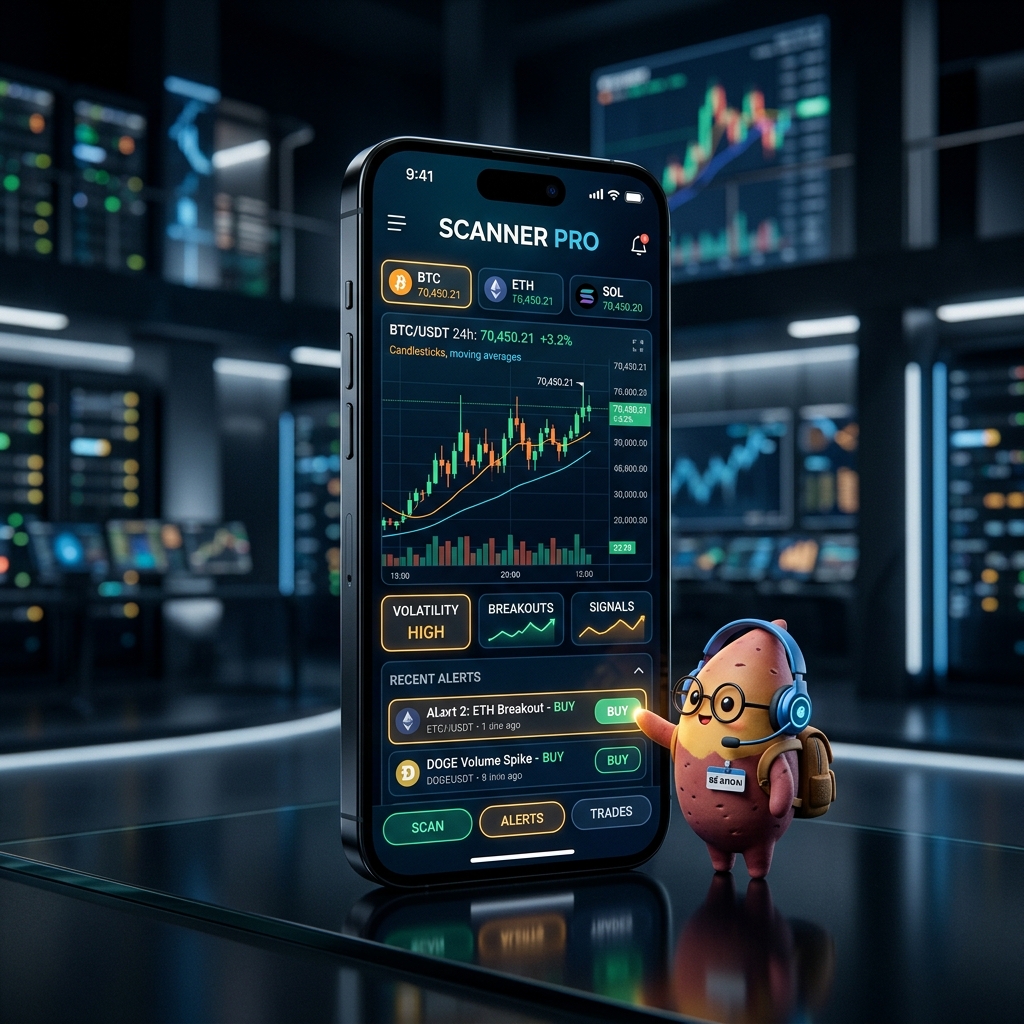
Trading Starter Masterclass
Master core technical foundations, 4 foundational frequency patterns, institutional risk management, and dismantle the 4 psychological traps destroying 95% of beginners.
GEM Scanner PRO (1 Year)
Automatically scans 24 high-probability frequency patterns, calculating precise R:R metrics, entries, stop losses, and take profits objectively to eliminate emotional noise.

Huyen Kim Tru (Cat Golden Grey)
Premium natural crystal pillar crafted to transmute workstation stress, anchor autonomic calm, and protect your personal biofield during high-stakes decisions.
Research & Academic Bibliography (24 Sources)
- Lo, A. W., & Repin, D. V. (2002). The psychophysiology of real-time financial risk processing. Journal of Cognitive Neuroscience, 14(3), 323-339.
- Coates, J. M., & Herbert, J. (2008). Endogenous steroids and financial risk taking on financial exchange. PNAS, 105(16), 6167-6172.
- Coates, J. (2012). The Hour Between Dog and Wolf: How Risk-Taking Transforms Us, Body and Mind. Penguin Books.
- Damasio, A. R. (1994). Descartes' Error: Emotion, Reason, and the Human Brain. Putnam Publishing.
- Douglas, M. (2000). Mastering The Zone: Master the Market with Confidence, Discipline and a Winning Attitude. NYIF.
- Kahneman, D. (2011). Thinking, Fast and Slow. Farrar, Straus and Giroux.
- Steenbarger, B. N. (2002). The Psychology of Financial Markets: Tools and Techniques for Minding the Markets. John Wiley & Sons.
- Steenbarger, B. N. (2006). Enhancing Market Performance: Proven Strategies from the Cutting Edge of Psychology. Wiley.
- Hawkins, D. R. (2002). Power vs. Force: The Hidden Determinants of Human Behavior. Hay House.
- Thaler, R. H. (2015). Misbehaving: The Making of Behavioral Economics. W. W. Norton & Company.
- Tversky, A., & Kahneman, D. (1974). Judgment under Uncertainty: Heuristics and Biases. Science, 185(4157), 1124-1131.
- Ariely, D. (2008). Predictably Irrational: The Hidden Forces That Shape Our Decisions. HarperCollins.
- Sapolsky, R. M. (2004). Why Zebras Don't Get Ulcers. Holt Paperbacks.
- McCraty, R., Atkinson, M., & Tomasino, D. (2001). Science of the Heart: Exploring the Role of the Heart in Human Performance. HeartMath.
- Greene, R. (2018). The Laws of Human Nature. Viking.
- Greene, R. (2012). Mastery. Viking.
- Fenton-O'Creevy, M., et al. (2005). Market Risk: Decisions, and Management in Financial Markets. Oxford University Press.
- Peterson, R. L. (2007). Inside the Investor's Brain: The Power of Mind Over Money. John Wiley & Sons.
- Goleman, D. (1995). Emotional Intelligence: Why It Can Matter More Than IQ. Bantam Books.
- Taleb, N. N. (2001). Fooled by Randomness: The Hidden Role of Chance in Life and in the Markets. Texere.
- Cialdini, R. B. (2006). Influence: The Psychology of Persuasion. Harper Business.
- Shafir, E., & Mullainathan, S. (2013). Scarcity: Why Having Too Little Means So Much. Times Books.
- Dispenza, J. (2017). Becoming Supernatural: How Common People Are Doing the Uncommon. Hay House.
- GEM Academy. (2026). GEM Frequency Trading Whitepaper (SSOT Master Edition). GEM Publishing.