Probability vs Certainty: Demystifying AI Confidence Scores & Trader Survival Principles
Probability vs Certainty:
Demystifying AI Confidence Scores & Trader Survival Principles
"Financial markets are not an arena for prophets seeking certainty. They are a game of probability for risk managers - where a 40% win rate can generate massive wealth, while the illusion of 90% accuracy can wipe out an entire account overnight."

01 PSYCHOLOGICAL TRAP: THE TRAGEDY OF FALSE CERTAINTY
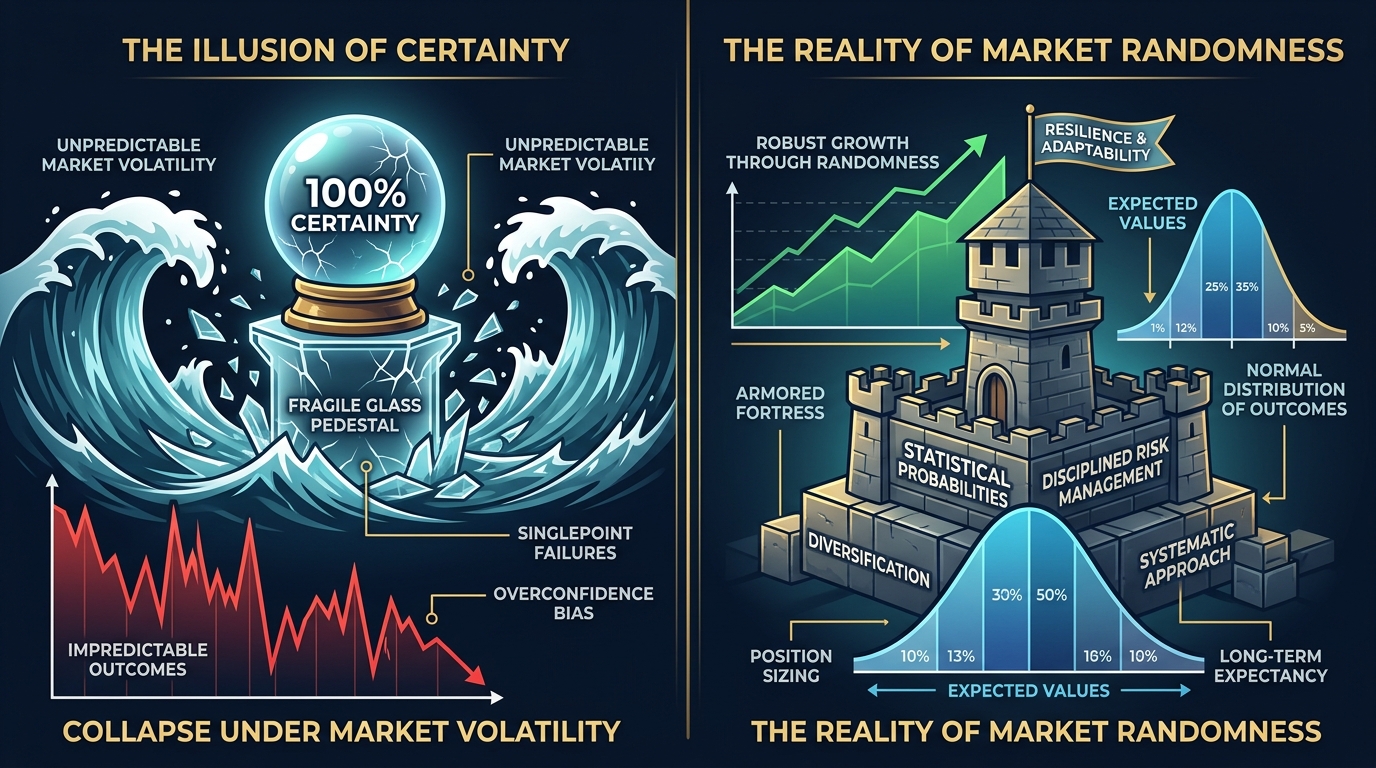
Imagine a familiar evening: You sit before your market monitor and identify a textbook technical setup aligning flawlessly. All momentum indicators point in the same direction, volume surges, and your intelligent scanning system flags Confidence: 85%. A surge of dopamine rushes through your veins. Your mind leaps to an immediate conclusion: "This trade cannot possibly lose!"
Mesmerized by the 85% figure, you quadruple your standard position size, dial up the leverage, and reassure yourself that you will quickly secure profits in minutes. Yet 15 minutes after entering, an unexpected macroeconomic headline breaks. Price violently whipsaws against your position across two brutal candles, liquidating your margin before you can comprehend what happened. To add insult to injury, immediately after clearing your stops, price rallies aggressively along your initial projection.
The Core Pain: The market was not wrong. The pattern was not flawed. What truly destroyed your capital was the fatal confusion between 'High Probability' and 'Absolute Certainty'. Millennia of human evolution wired our brains to crave certainty for survival. But in financial markets, bringing a 100% certainty mindset into an environment governed purely by stochastic probability is the fastest route to ruin.
02 THE MATHEMATICAL NATURE OF CONFIDENCE SCORE % IN AI SCANNERS
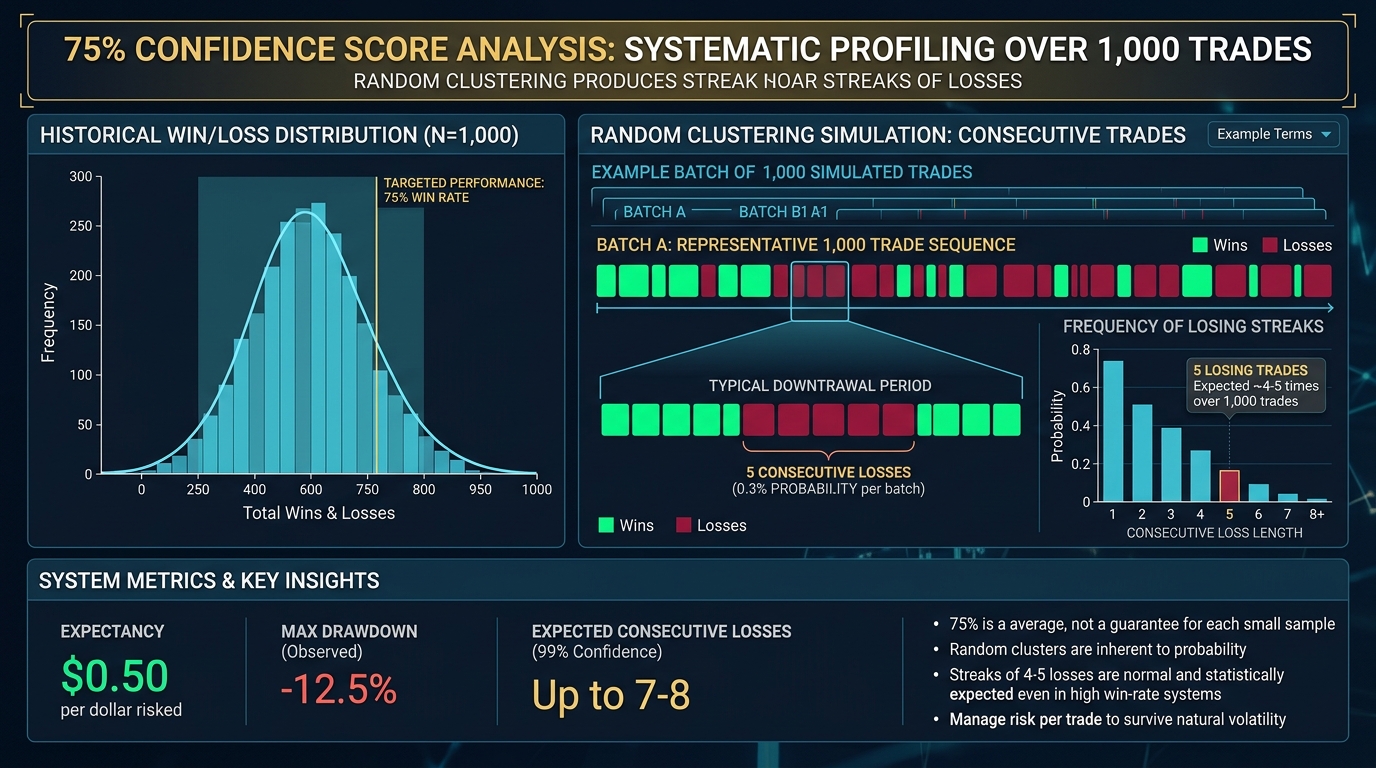
Many retail traders seeing an automated system flag a 75% Confidence Score naively believe: "This trade has a 75% chance of making money and only 25% risk, so I should bet big." This is a fundamental misunderstanding of statistical math.
In quantitative finance and data science, a 75% Confidence Score is defined precisely as follows:
PRECISE QUANTITATIVE DEFINITION
"Across a historical dataset of 1,000 instances matching identical structural, volume, and volatility constraints: Exactly 750 times price reached the take-profit target before hitting stop loss, and 250 times price hit stop loss first."
The crucial reality you must internalize: The distribution of those 250 losing trades is completely random!
Probability theory dictates that even in a verified 75% win-rate system, encountering 4 to 5 consecutive losses within a 100-trade sequence is mathematically expected (the probability of a 4-loss streak is 0.25^4 = 0.39% at any starting trade, which across a 100-trade sample is virtually guaranteed to occur). If you overleverage and risk 20% of your balance per trade seeking certainty, that random 5-loss cluster will erase 67% of your capital, making recovery nearly impossible.
03 5 FATAL PITFALLS WHEN EQUATING PROBABILITY WITH CERTAINTY
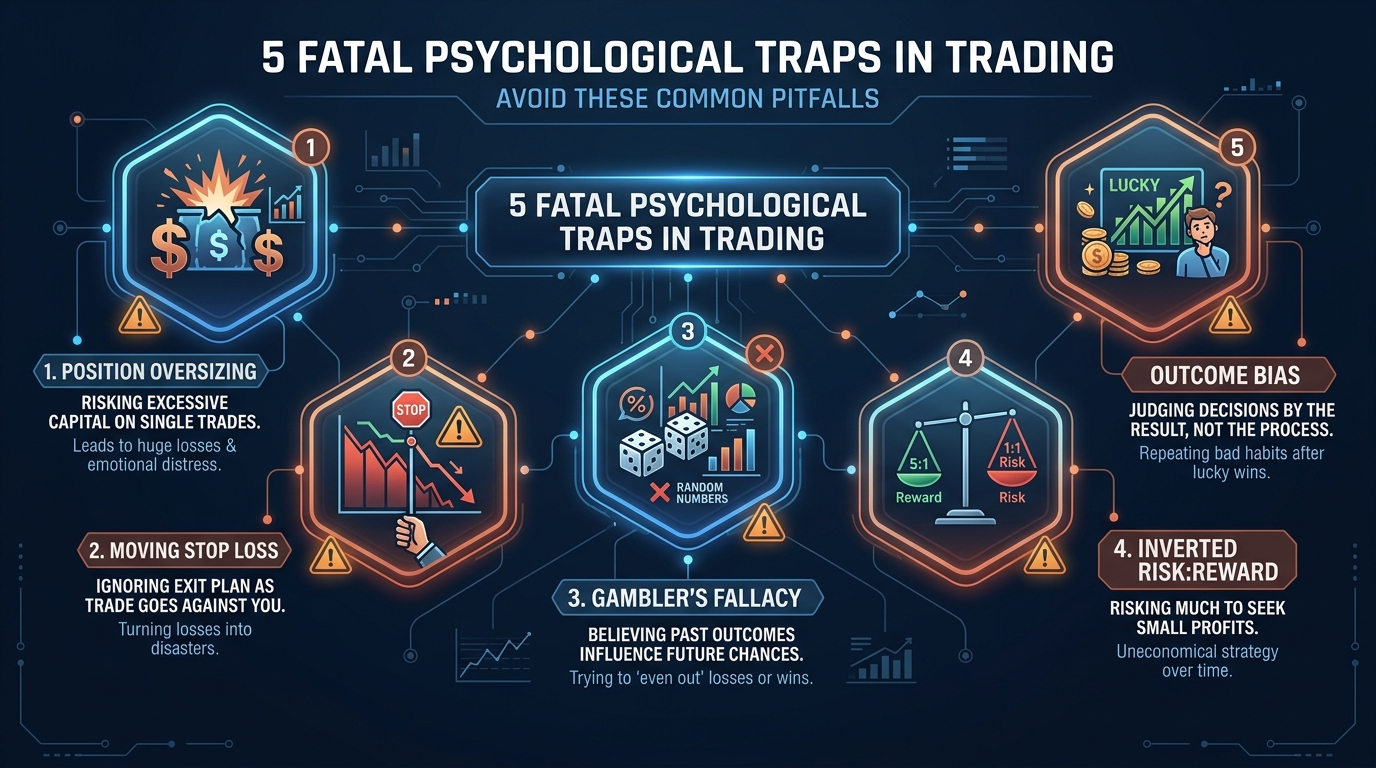
1. Position Oversizing
Believing a trade has an 80% chance of winning, traders inflate risk from their normal 1-2% up to 10-30% of their total balance. They forget that hitting 3 consecutive losses in the 20% random bucket causes catastrophic drawdown, triggering emotional panic and destroying systematic execution.
2. Moving or Cancelling Stop Losses
Rationalizing that "this pattern is too reliable, price is just experiencing noise before rebounding", traders continuously drag stop losses deeper as the market moves against them. They transform a calculated small loss into a bottomless disaster because their ego refuses to accept that this trade belongs to the natural loss fraction of the system.
3. Gambler's Fallacy & Revenge Trading
After suffering 3 consecutive losses on high-confidence setups, traders assume the 4th trade "must win due to the law of averages". They double down to recover losses (Martingale), failing to recognize that each trade is an independent event unaffected by previous results.
4. Inverted Risk:Reward Ratio Paradox
To achieve a superficial 85-90% win rate, many traders take tiny profits (gaining 10 points) while risking massive stops (losing 100 points). This inverted 1:10 R:R creates an illusion of perpetual success for weeks, until a single sudden flash drop wipes out an entire year of gains.
5. Outcome Bias
Judging a decision as 'good' simply because it generated profit, or 'bad' because it hit stop loss. A reckless trade violating all rules that gets lucky is still a disastrous decision (reinforcing bad habits). Conversely, a trade adhering 100% to systematic edge that hits stop loss is an exceptional decision (the cost of doing business).
04 EXPECTED VALUE (EV) - THE METRIC SEPARATING PROFESSIONALS FROM GAMBLERS
In elite quantitative hedge funds and professional trading institutions, nobody cares about how many times an individual predicts the market correctly. The sole metric governing survival and compounding wealth is Expected Value (EV).
Expected Value defines the average outcome of a trading decision repeated over a large sample:
If EV > 0, the system possesses a statistical edge. Repeated across sufficient trials, profit becomes mathematically inevitable.
Let us contrast two real-world trading strategies:
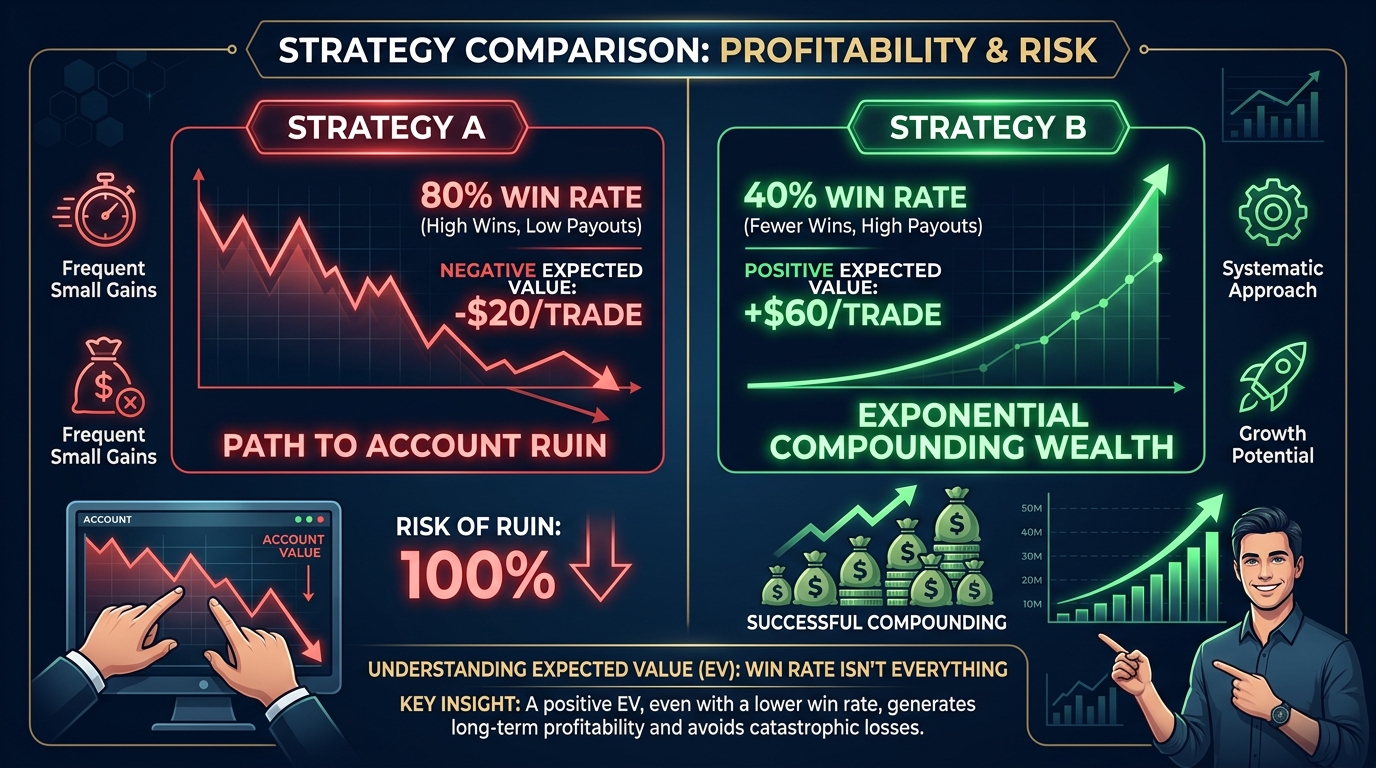
STRATEGY A (High Win Rate Illusion)
- • Win Rate: 80% (High win rate)
- • Average Gain per Winning Trade: +$100
- • Average Loss per Losing Trade: -$500 (R:R = 1:5)
- • EV Calculation:
(0.80 * 100) - (0.20 * 500) = 80 - 100 = -$20
Verdict: Bleeds $20 on average per trade. Account ruin is guaranteed over time.
STRATEGY B (Asymmetric Advantage)
- • Win Rate: 40% (Below half)
- • Average Gain per Winning Trade: +$300
- • Average Loss per Losing Trade: -$100 (R:R = 3:1)
- • EV Calculation:
(0.40 * 300) - (0.60 * 100) = 120 - 60 = +$60
Verdict: Generates +$60 on average per trade. Yields +$6,000 net profit over 100 trades.
When you internalize Expected Value, your mind is liberated from the anxiety of 'having to guess right'. You accept losing trades as smoothly as a retail store pays utility bills - merely operating costs required to extract asymmetric returns from larger winning runs.
05 STRATEGIC LENS: THE LAW OF SUPREME REALISM & DEFENSIVE MASTERY
In his seminal works The 48 Laws of Power and The 33 Strategies of War, strategist Robert Greene articulated an invariant law of human endeavor: The Law of Supreme Realism.
STRATEGIC REALISM PRINCIPLE
"The greatest mistake in strategy is confusing what you want to happen with what is actually happening. The amateur seeks emotional security through imagined certainty; the master embraces uncertainty and constructs an unbreakable defensive fortress."
Financial markets represent second-order chaotic systems where the aggregated actions of millions constantly reshape liquidity structures. No individual or artificial intelligence model can command the future. Claiming '100% certainty' is the epitome of strategic arrogance.
A true strategist never bets their survival on a single battle. They approach markets with mathematical humility: Planning for worst-case scenarios before envisioning victory, severing failed setups without hesitation, and letting edge compound systematically over the long horizon.

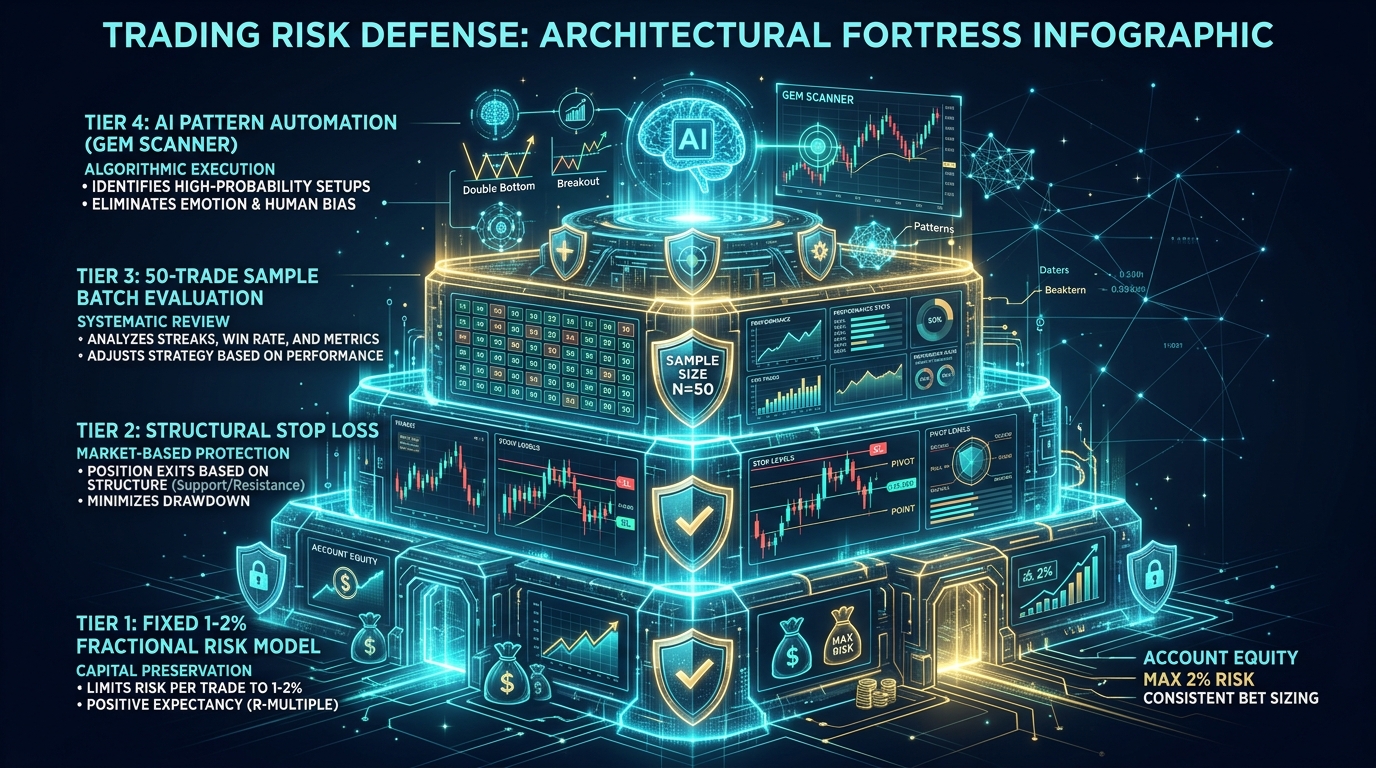
06 4-LAYER DEFENSE ARCHITECTURE: CONVERTING PROBABILITY INTO SUSTAINABLE EDGE
TIER 1 Fixed 1-2% Fractional Risk Model
Regardless of pattern conviction, maximum loss per trade must never exceed 1% to 2% of total equity. Under this rule, even enduring 10 consecutive losses preserves 80-90% of account purchasing power, keeping you fully equipped to capture subsequent winning cycles.
TIER 2 Structural Stop Loss Placement
Stop losses are never placed arbitrarily by dollar amounts, but anchored strictly at technical invalidation levels (beneath key swing lows or outside liquidity pools). Position size is calculated backwards from entry to structural stop to lock risk at exactly 1-2%.
TIER 3 50-100 Trade Sample Batch Discipline
Cease altering strategies after 2-3 losing trades. The Law of Large Numbers requires sufficient sample size. Execute systematically in blocks of 50 to 100 trades, maintain structured trade logs, and only audit win rate, R:R, and EV upon completing the full batch.
TIER 4 Algorithmic Pattern Automation (GEM Scanner PRO)
Human cognition under fatigue is prone to emotional bias. Deploying quantitative tools like GEM Scanner PRO filters market noise, automates multi-timeframe confidence scoring, and alerts you exclusively when verified confluence criteria align.
07 5 INVIOLABLE RULES DERIVED FROM THIS LESSON
Probability is not certainty: A 75% confidence score only manifests across 1,000 trades; the outcome of your next trade is always random.
Expected Value (EV) reigns supreme: A 40% win-rate system with 3:1 R:R perpetually outperforms an 85% win-rate system with 1:10 R:R.
Enforce 1-2% risk ceiling: Never risk over 2% of total equity on any single idea, regardless of pattern aesthetic.
Decouple process from outcome: A winning trade violating rules is a strategic disaster; a losing trade executed with discipline is a professional success.
Merge technology and discipline: Utilize AI scanners to eliminate cognitive bias, maintain psychological peace, and free up your time.
Master Probability - Construct a Sustainable Trading System
Understanding mathematical probability is your starting foundation. To build a genuine market edge, you need structured masterclasses, quantitative AI scanners, and mental clarity to sustain iron discipline.

Trading Starter Masterclass Tier 1 Foundation
Master probability thinking, institutional risk management, and professional price action execution.

GEM Scanner PRO
Automated AI pattern detection calculating multi-timeframe confidence scores in real-time.

Supreme Amethyst Crystal Set
High-vibrational natural crystals to purify mental noise, release anxiety, and anchor emotional discipline.

Experience GEM Scanner on Mobile
Scan the QR code to install the GEMRAL app. Your AI companion for peaceful and effective trading.
Free • iOS & Android • No Credit Card Required